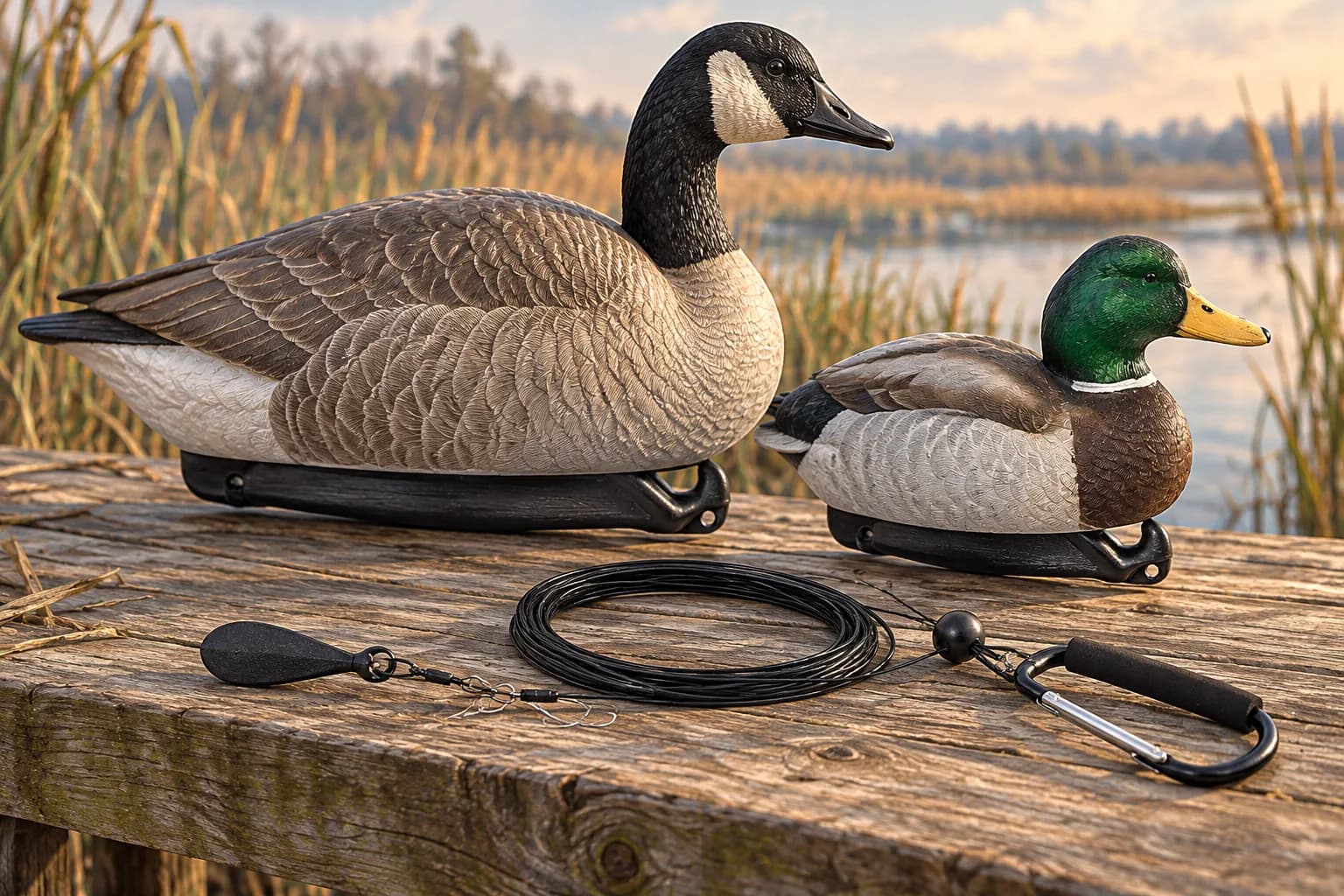
A Texas rig can work with a floating goose decoy when the connection, line length and anchor suit that particular decoy and site. The word "goose" does not establish compatibility. Large floaters, lightweight floaters, tail-up feeders and field decoys have different bodies and rigging needs.
Lead image: AI-generated editorial illustration based on Lirben product photos. Refer to the product listing for exact appearance and supplied contents.
Start with a floater, not the species label
Step 1
Identify the goose-decoy type
Distinguish floating bodies from field decoys and identify the maker's intended rigging.
Identify the exact decoy model and whether it is intended to float. Find its rigging instructions and approved attachment point. A field shell, silhouette or full-body stake decoy is not automatically suitable for a water anchor.
Manufacturers build more than one type of goose decoy. Higdon's goose-decoy catalog includes full bodies, shells, silhouettes and floating equipment. Selecting a rig by species alone misses those construction differences.
Conventional goose floater
- First compatibility check
- The intended keel eye and an anchor sized for the actual placement
- What not to assume
- That a duck rig will hold every goose body
Tail-up feeder floater
- First compatibility check
- Its intended floating posture and specific connection arrangement
- What not to assume
- That an unfamiliar angle means the decoy is sinking
Field shell or full body
- First compatibility check
- The supplied stake or support instructions
- What not to assume
- That an anchor turns it into a floating decoy
Silhouette or windsock
- First compatibility check
- The intended field mounting system
- What not to assume
- That it belongs on an individual water rig
| Feature | First compatibility check | What not to assume |
|---|---|---|
| Conventional goose floater | The intended keel eye and an anchor sized for the actual placement | That a duck rig will hold every goose body |
| Tail-up feeder floater | Its intended floating posture and specific connection arrangement | That an unfamiliar angle means the decoy is sinking |
| Field shell or full body | The supplied stake or support instructions | That an anchor turns it into a floating decoy |
| Silhouette or windsock | The intended field mounting system | That it belongs on an individual water rig |
For an example of a specialized floating design, Higdon describes its Magnum Goose Butt as using a weighted keel with a short-stringing arrangement. That is a feature of that model. It does not establish a universal attachment method or prove compatibility with Lirben hardware.
Check the keel and usable line reach
Step 2
Check the connection and reach
Confirm attachment clearance and enough usable line for the actual placement.
Inspect the maker-approved eye or attachment, close the snap fully, and check that the hardware can move without binding against the keel. Measure the finished usable reach before choosing the water depth.
Do not force a small clip over an oversized eye or assume a closed gate has enough clearance. The swivel and cable should follow their intended path without rubbing a sharp edge or locking the connection. If the approved point will not accept the rig correctly, choose compatible hardware or another complete rig.
The attachment guide covers the connection check in detail. The line and hardware guide covers matching components when replacement parts are needed.
A larger body can also change the space available for swing and movement. Check the whole rig as deployed. Do not shorten a line to keep a goose closer to the pattern if it already barely reaches bottom. A taut line can affect posture or pull on the anchor. Read the line-length guide before changing a factory assembly.
Check hold with the actual floater
Step 3
Observe one complete rig
Test a retrievable placement and watch posture, line freedom and progressive drift.
From safe access, place one decoy where the anchor can reach bottom and you can retrieve it. Let it settle, observe its intended posture and watch its position against a fixed shoreline reference. Repeat the check when conditions change.
There is no universal goose-to-duck anchor-weight conversion. Body size, exposed profile, water movement, bottom and line reach all affect the setup. More ounces add carry load, but cannot fix a line that is too short or an attachment that binds.
Tanglefree's mushroom-anchor guidance distinguishes its lighter duck application from heavier goose-floater and oversized-decoy applications. Treat that as guidance for its products. It supports checking the actual body and anchor together, not applying its ounce recommendations to a different shape or claiming all goose floaters need one weight.
A holding anchor can still allow its decoy to swing. Progressive relocation is different. If the anchor drags, inspect bottom contact, line reach and the connection before choosing a different weight, shape, system or placement. Use the diagnostic guide and anchor-shape comparison for that decision.
Recover an unsuitable setup while it remains safely accessible. Do not leave it in place because a smaller duck decoy nearby is holding.
What Lirben's light-goose description means
The Lirben 6 oz 12-pack is cataloged for duck and light goose decoys in shallow water up to 3 ft. Each rig has a 6 oz flat bank weight on 48-inch PVC-coated steel cable. The cable length is not a 4 ft working-depth promise.
The catalog does not define a tested goose-decoy size, brand list, wind-speed rating or current-speed rating. "Light goose" should therefore be treated as a limited intended application that still needs the checks above. It is not an assurance for every Canada goose floater, large-body decoy or exposed-water set.
If a heavier anchor or substantially longer line is needed, select equipment built for that task. Lirben's current catalog does not offer a separate heavy-goose rig or a longline kit.
Mixing floating ducks and geese
Keep each independently anchored decoy responsible for its own hold. A heavier goose anchor does not stabilize nearby duck rigs. Leave enough room for each body's movement and avoid crossed lines between species groups.
Plan the spread count and layout around the water and recovery access. For carrying, weigh actual goose bodies and bags rather than borrowing a duck-only load estimate. Keep large floaters and their rigs in identifiable groups during pickup.
Ducks Unlimited's transport guidance recommends protecting flocked heads and describes slotted bags for separating bodies. Keep loose anchors away from those surfaces and check where cable or clips rub the keel. Transport damage can change a connection that fitted correctly before the trip.
Common questions
Are 6 oz weights enough for goose floaters?
They may suit some light floaters in appropriate shallow conditions, but the size label alone cannot establish hold. Check the decoy maker's instructions, actual line reach, bottom contact and drift.
Can one anchor hold two goose decoys?
An individual rig is intended to anchor one decoy. Connecting several bodies changes the load and system. Choose an appropriate gang-rig system if a shared mainline is the task.
Can I use strap weights instead of Texas rigs?
A compatible strap or J-style rig is another option. Some store wrapped line against the body or keel, while Texas-style rigs commonly gather carrying loops. Compare the anchor forms and handling systems, then check the particular decoy and water. Neither storage method establishes holding power.
Can I use the same carrying clip for duck and goose rigs?
Use its intended gear-carrying arrangement and keep the groups manageable. Do not treat a shared carrying clip as an underwater mainline or a load-rated safety fitting.
Sources and limits
Manufacturer links establish examples of decoy types, specialized keel designs and product-specific anchor guidance. The fit checklist is conditional planning guidance. No cross-brand compatibility test, holding-power test or universal goose anchor rating is claimed.
For your next setup
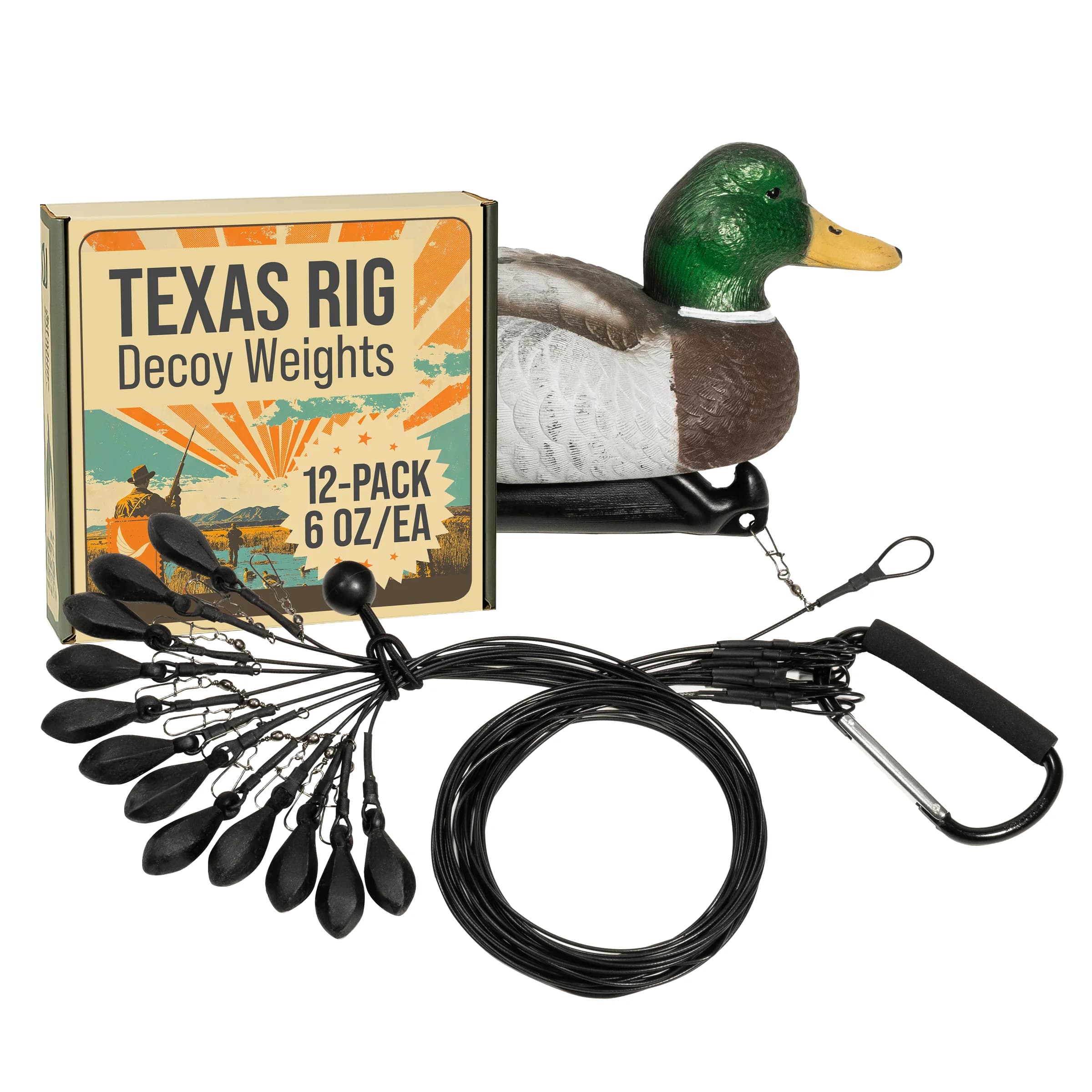
Lirben Texas Rig Decoy Weights - 6 oz (12-Pack)
Twelve individual rigs. Choose the fit for your water.