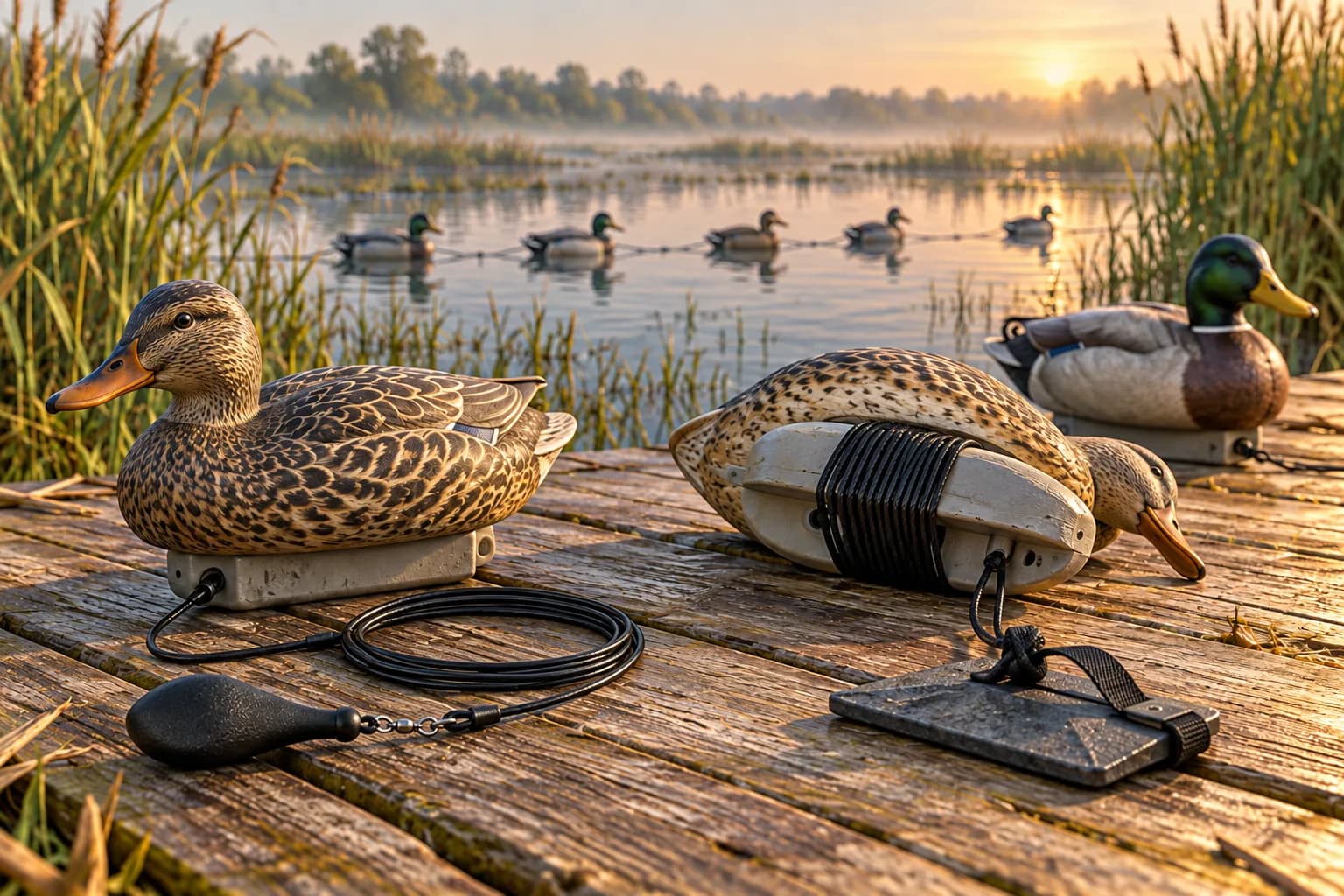
Texas rigs suit individually placed decoys in shallow water when the line reaches the bottom with room for movement. Traditional wrap rigs suit hunters who prefer storing line on each decoy. Longlines connect several decoys to a shared main line and can suit larger, deeper-water spreads. Choose around your water and pickup routine.
Lead image: AI-generated editorial illustration based on Lirben product photos. Refer to the product listing for exact appearance and supplied contents.
What changes between these rigging systems?
A standard wrap rig gives each decoy its own line and anchor. You wrap that line onto the decoy for storage. A Texas rig also anchors decoys individually, but its looped-line arrangement supports a different pickup and bundling routine. A gang rig, often called a longline, uses short decoy drops attached to a shared main line. Ducks Unlimited explains these three systems in its rigging overview.
The name alone does not describe every connection. Some Texas rigs have a sliding weight; others have a fixed weight and sliding decoy connection. Heyday's FAQ describes its fixed-weight design. Check the particular kit rather than assuming that all Texas rigs assemble or retrieve the same way.
Anchor arrangement
- Texas rig
- One per decoy
- Wrap rig
- One per decoy
- Longline
- Shared main line
Placement
- Texas rig
- Independent
- Wrap rig
- Independent
- Longline
- Along the line
Depth planning
- Texas rig
- Match rig length
- Wrap rig
- Manage usable line
- Longline
- Plan line and drops
Pickup organization
- Texas rig
- Gather loops
- Wrap rig
- Wrap each line
- Longline
- Manage drops and main line
Transport choice
- Texas rig
- Bundle or bag
- Wrap rig
- Wrapped decoys
- Longline
- Organized line system
| Feature | Texas rig | Wrap rig | Longline |
|---|---|---|---|
| Anchor arrangement | One per decoy | One per decoy | Shared main line |
| Placement | Independent | Independent | Along the line |
| Depth planning | Match rig length | Manage usable line | Plan line and drops |
| Pickup organization | Gather loops | Wrap each line | Manage drops and main line |
| Transport choice | Bundle or bag | Wrapped decoys | Organized line system |
Choose around the hunt you actually make
Step 1
Start with the water and access
Measure depth, note current and decide how you will set and retrieve the spread.
Start with the deepest planned decoy position, not just the water beside your access point. A fixed-length individual rig needs enough usable reach for the decoy to float without pulling directly against the anchor. Waves, a sloping bottom and changing water levels can reduce your margin.
A longline changes the arrangement, but its name does not guarantee that its anchors will hold. Its main line, drops and anchoring still need to fit the water. Read the line-length guide before deciding whether a short individual rig reaches your planned spots.
Step 2
Choose independent placements or a main line
Match the anchoring system to how independently each decoy needs to move.
Picture the positions you want to adjust during the hunt. Independent rigs let you move one decoy without relocating a shared main line. That can be useful when you want scattered small groups or need to shift a few decoys around vegetation.
A longline organizes several decoys along one system. That arrangement may fit a line of open-water decoys, but it adds a main line that you must route and manage. Decide where it will lie and how you will retrieve it before adding it to the spread.
Step 3
Check the complete handling routine
Compare attachment, pickup, transport and storage before buying or converting rigs.
Handle one complete rig before converting a dozen. Attach it to the actual keel or eyelet, gather it for carry and undo the bundle again. Check whether the connection opens easily and whether the weight and line stay organized.
Compare your transport method too. A hand-carried bundle, a slotted bag and a boat tub impose different limits. Keep the main line and individual lines clear of people, dogs and boat equipment while handling the spread. The storage and transport guide covers the individual-rig routine.
When would you keep a wrap rig?
Keep it when your existing line and anchors fit the water and your wrapping routine works. Switching every decoy adds cost and work. A different system only helps if it solves a problem you have, such as inconvenient pickup, line management or unsuitable length.
Inspect an older wrap rig before reusing it. A damaged line, weak connection or poor anchor match remains a problem regardless of the storage method. See the line and hardware guide for checks that apply across systems.
Where does the Lirben kit fit?
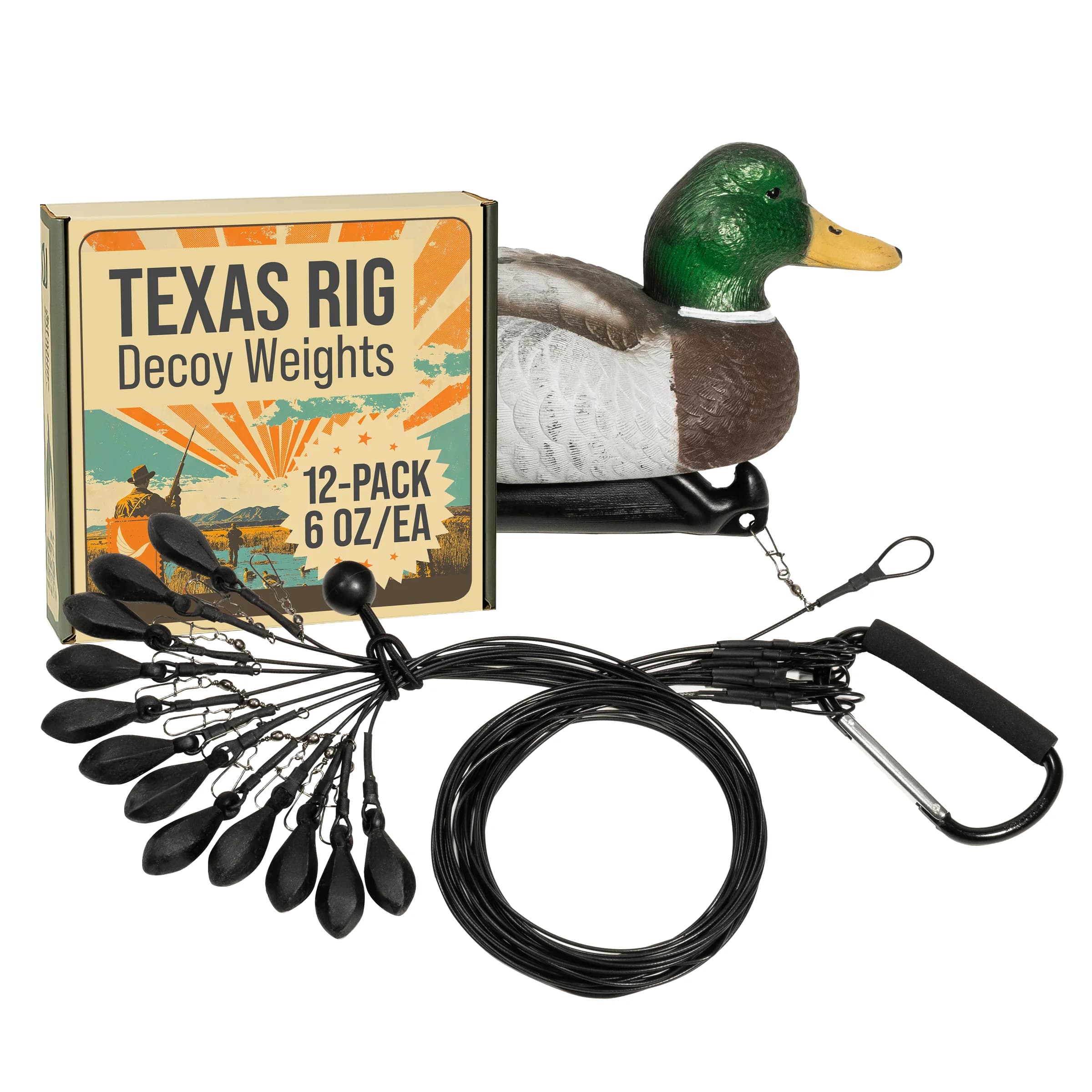
The Lirben 6 oz Texas rig kit contains 12 pre-rigged individual anchors with 48-inch PVC-coated steel cable. It includes stainless swivels, aluminum crimps, a cushioned carabiner and a bungee ball. Decoys are separate.
Consider it when those fixed specifications fit the decoys and measured water you plan to hunt. It is an individual rigging kit. If you need a shared main line, substantially longer rigs or a different anchor, choose equipment built for that need. Use the weight-selection guide to assess the 6 oz anchor rather than treating it as a universal size.
Questions before you switch
Are Texas rigs always better than wrap rigs?
No. They offer a different handling routine. Your depth, connections, transport and existing equipment decide whether that routine is useful. Neither system compensates for damaged hardware or an anchor that drags.
Can you mix systems in one spread?
You can plan separate groups around different systems, provided you keep their lines clear and can retrieve each group safely. There is no need to convert suitable equipment merely to make everything match.
Should you build your own rigs instead?
DIY gives you control over components and lengths. A pre-rigged kit provides an assembled starting point. Compare the parts and work involved in DIY versus pre-rigged decoy rigs, then follow the complete Texas rig setup guide for the individual-rig workflow.
For your next setup
Lirben Texas Rig Decoy Weights - 6 oz (12-Pack)
Twelve individual rigs. Choose the fit for your water.