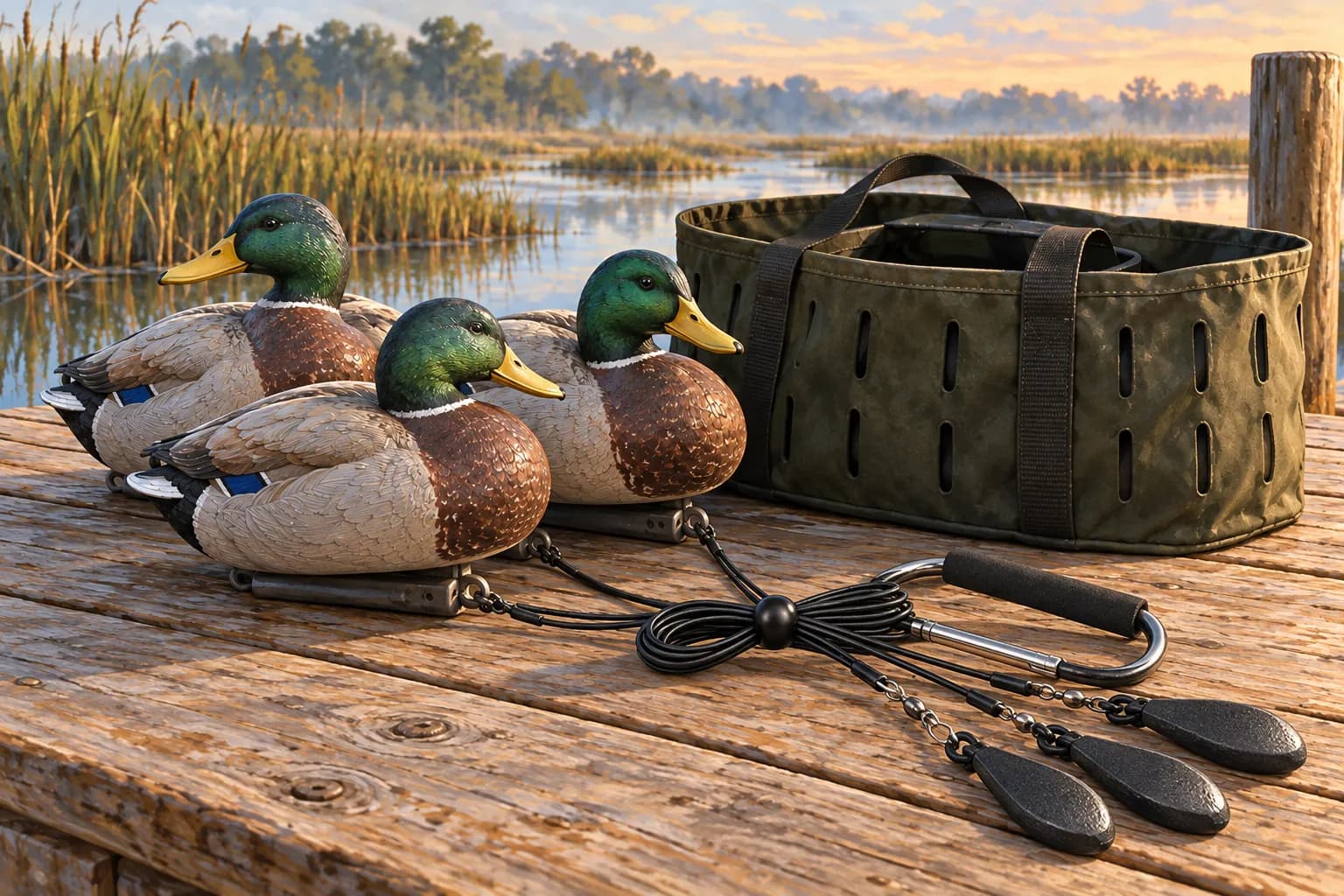
Store Texas-rigged decoys by separating crossed lines, gathering the intended carrying loops and controlling loose anchors. Remove plants and mud, drain wet gear and let it dry before long-term storage. Keep different line lengths in separate groups so the next setup begins with the rigs you actually need.
Lead image: AI-generated editorial illustration based on Lirben product photos. Refer to the product listing for exact appearance and supplied contents.
Separate rigs as you pick up
Step 1
Pick up one rig at a time
Retrieve each rig from safe access and remove crossed lines before adding it to a group.
Work from a safe bank or properly managed boat. Bring in one decoy and its anchor, check that the line is free of adjacent rigs, and only then add it to the carry group. Stop and separate a crossing rather than pulling harder on the whole bundle.
A tangle-resistant rig can still tangle when loose loops cross, an anchor passes through another line or the bundle tumbles during transport. Look at where the crossing began. A repeated snag at one connection calls for a hardware inspection; repeated mixing of long and short lines calls for separate groups.
Do not chase a drifting decoy into unsafe water. Plan the retrieval route while placing the set. The complete rigging guide covers that sequence.
Untangle a crossed group without tightening it
Once the affected rigs are safely ashore, stop carrying the bundle by the tangled lines. Put the decoys and anchors on a clear surface so their weight is supported. Then work on one crossing at a time.
- Remove the affected rigs from the carrying clip while keeping the untangled group together.
- Trace one line from its decoy connection to its own anchor. Identify which other loop or line it passes through.
- Give that crossing slack. Reverse the route that created it rather than pulling both ends tighter.
- If the rig has a removable snap designed for the decoy connection, you can disconnect it to free a crossing, then reconnect it by the attachment guide. Do not open crimps or force closed fittings apart.
- Inspect the freed line and hardware. Put a kinked, cut or doubtful assembly aside instead of adding it straight back to the bundle.
Return the sound rig to its length group with the anchor controlled. If the same connection catches repeatedly, use the symptom guide to investigate the route, moving part or snag. More force does not tell you which line goes where.
Gather loops and control weights
Step 2
Group the carrying loops
Keep similar rigs together and keep anchors from swinging into other gear.
Use the rig's intended carrying loop and supplied connector arrangement. Group rigs of similar length, settle weights together and secure the bundle without forcing tight bends into coated cable. Keep the carabiner gate clear of trapped line.
Treat each group as a manageable load. For twelve 6 oz rigs, anchors alone weigh 4.5 lb; the decoys, lines and accessories add more. Dividing a spread into smaller groups can make handling easier, particularly when carrying other equipment. No carry accessory should be assumed to be climbing or personal-safety equipment.
Carabiner bundle or decoy bag?
Carabiner bundle
- What it helps with
- Keeping carrying loops together for a small set
- What to watch
- Loose anchors, overloaded groups and cable caught in the gate
Slotted bag
- What it helps with
- Separating decoy bodies during transport
- What to watch
- Lines crossing between slots and anchors rubbing painted bodies
Open gear tote
- What it helps with
- Keeping a settled bundle contained in a vehicle
- What to watch
- Wet gear left enclosed and heavy items crushing cable
| Feature | What it helps with | What to watch |
|---|---|---|
| Carabiner bundle | Keeping carrying loops together for a small set | Loose anchors, overloaded groups and cable caught in the gate |
| Slotted bag | Separating decoy bodies during transport | Lines crossing between slots and anchors rubbing painted bodies |
| Open gear tote | Keeping a settled bundle contained in a vehicle | Wet gear left enclosed and heavy items crushing cable |
Choose based on the route, decoy size and the rig's instructions. A bag does not remove the need to organize lines. A bundle does not protect every painted surface from every anchor.
Plan the whole trip separately from this bundling routine. The walk-in load guide includes decoys, anchors, bag and other equipment. For a small boat, the kayak setup guide covers keeping the load and loose lines out of the working area.
Clean and dry before storage
Step 3
Clean, drain and dry
Remove aquatic material and drain equipment before transport, then dry and inspect it.
Remove visible plants, animals and mud before leaving the access point. Drain water from equipment. Clean and dry decoys, anchors, bag pockets and the spaces around crimps and swivels before storing them closed up.
The U.S. Fish and Wildlife Service's Clean, Drain, Dry guidance explains how equipment can carry aquatic invasive species between waters. Follow the destination's current requirements and the gear manufacturer's cleaning limits. Do not apply heat or chemicals without checking material compatibility.
After saltwater use, check the manufacturer's care directions for rinsing and drying. Coated cable still has exposed connections to inspect. Look for damaged coating, sharp strands, seized swivels, cracked decoy eyelets and sleeves that have moved. Set damaged rigs aside instead of hiding them in the next bundle.
Separate the dry departure load from the wet return
Clean, dry departure load
- How to organize it
- Keep selected length groups identifiable and ready to release
- Before the next use
- Check carrying gates, terminal snaps and the intended first group
Recovered wet equipment
- How to organize it
- Remove aquatic material and drain at access; contain the organized gear for the trip home
- Before the next use
- Unpack promptly for the appropriate cleaning, drying and inspection
Damaged or uncertain rig
- How to organize it
- Keep it separate from the usable bundle and identify the problem
- Before the next use
- Replace it or complete the approved support/repair process before repacking
| Feature | How to organize it | Before the next use |
|---|---|---|
| Clean, dry departure load | Keep selected length groups identifiable and ready to release | Check carrying gates, terminal snaps and the intended first group |
| Recovered wet equipment | Remove aquatic material and drain at access; contain the organized gear for the trip home | Unpack promptly for the appropriate cleaning, drying and inspection |
| Damaged or uncertain rig | Keep it separate from the usable bundle and identify the problem | Replace it or complete the approved support/repair process before repacking |
A return container controls the load during transport. It is not long-term storage for wet gear. Open bag pockets, separate crossed groups and let the cleaned equipment dry before closing it away. The maintenance guide covers salt/brackish exposure, between-water cleaning and the inspection sequence in detail.
Store with the next setup in mind
Step 4
Store ready for inspection
Protect decoys and cable from crushing, sharp bends and mixed lengths.
Keep dry rigs in broad, relaxed loops where they will not be crushed by batteries, other anchors or heavy equipment. Separate lengths and condition-specific groups with a simple bag or storage tag. Keep spare hardware in a closed container.
Before the next outing, open each bundle in daylight and run a visual check from decoy connection to anchor. Verify that swivels move and carrying gates close. If a line has a permanent sharp kink, exposed steel or a doubtful crimp, replace the affected assembly using appropriate instructions.
Make a preseason ready group
Ducks Unlimited's offseason storage advice includes cleaning decoys, checking crimps and keeping equipment protected. Turn that assessment into a ready group before the first departure:
- Count sound complete rigs, with damaged assemblies excluded.
- Check the intended lengths against the planned placements.
- Inspect each decoy eyelet, terminal fitting, swivel, sleeve and line.
- Check the carrying carabiner and storage bungee separately from the small decoy connector.
- Gather one selected group, release it again and confirm that no line is trapped in the gate.
- Keep replacements and maker instructions identifiable rather than mixing loose parts into the working bundle.
If hanging is supported by the equipment maker, use a suitable storage support that does not force tight bends or crush painted bodies. If storing in a bag or tote, allow room for relaxed line curves. One maker's recommendation to tie or hang a particular rig does not establish the right method for every material.
Can you leave decoys out overnight or all season?
Check the current rules for the exact property, hunting area and season, as well as any landowner authorization. Plan daily pickup unless a longer deployment is permitted. A storage label or another hunter's routine does not establish permission to leave equipment behind.
For a current area-specific example, the U.S. Fish and Wildlife Service's 2026–2027 waterfowl rules for John H. Chafee National Wildlife Refuge require waterfowl blinds and decoys to be removed at the end of each hunt day. That rule describes that refuge, not a nationwide retrieval deadline. Read the waterfowl section and the current refuge brochure rather than applying a different activity's equipment rules.
Daily pickup and a permitted longer-term spread need different routines:
- For daily pickup, keep a count of deployed decoys and rigs, allow time for the whole recovery route, and bring back the complete equipment. Then remove aquatic material, drain, clean and dry before storage or transfer.
- Where longer deployment is explicitly allowed, inspect the spread before each use and after changing weather or water. Check line reach, anchor hold, body condition, connections, fouling and access for eventual recovery. Retrieve affected equipment for proper inspection and care rather than treating a standing spread as maintenance-free.
Continuous exposure is a separate equipment-use question. Follow the maker's stated limits, and do not infer a season-long deployment rating from coated cable, stainless components or the phrase tangle-free. Permission to leave a spread does not prove that its gear or retrieval route remains suitable. Use the maintenance guide for inspection and the line-length guide when changing water affects reach.
Common questions
Should I tie a knot in coated steel cable?
Use the supplied storage method. A knot that works with one line material can damage or sharply bend another. Do not copy a monofilament storage technique onto coated steel cable without manufacturer guidance.
Can I keep different lengths on one clip?
You may be able to gather their loops, but separate groups are easier to identify and less likely to cross during deployment. Read the line-length guide before assigning each group to a depth.
What comes with the Lirben set for storage?
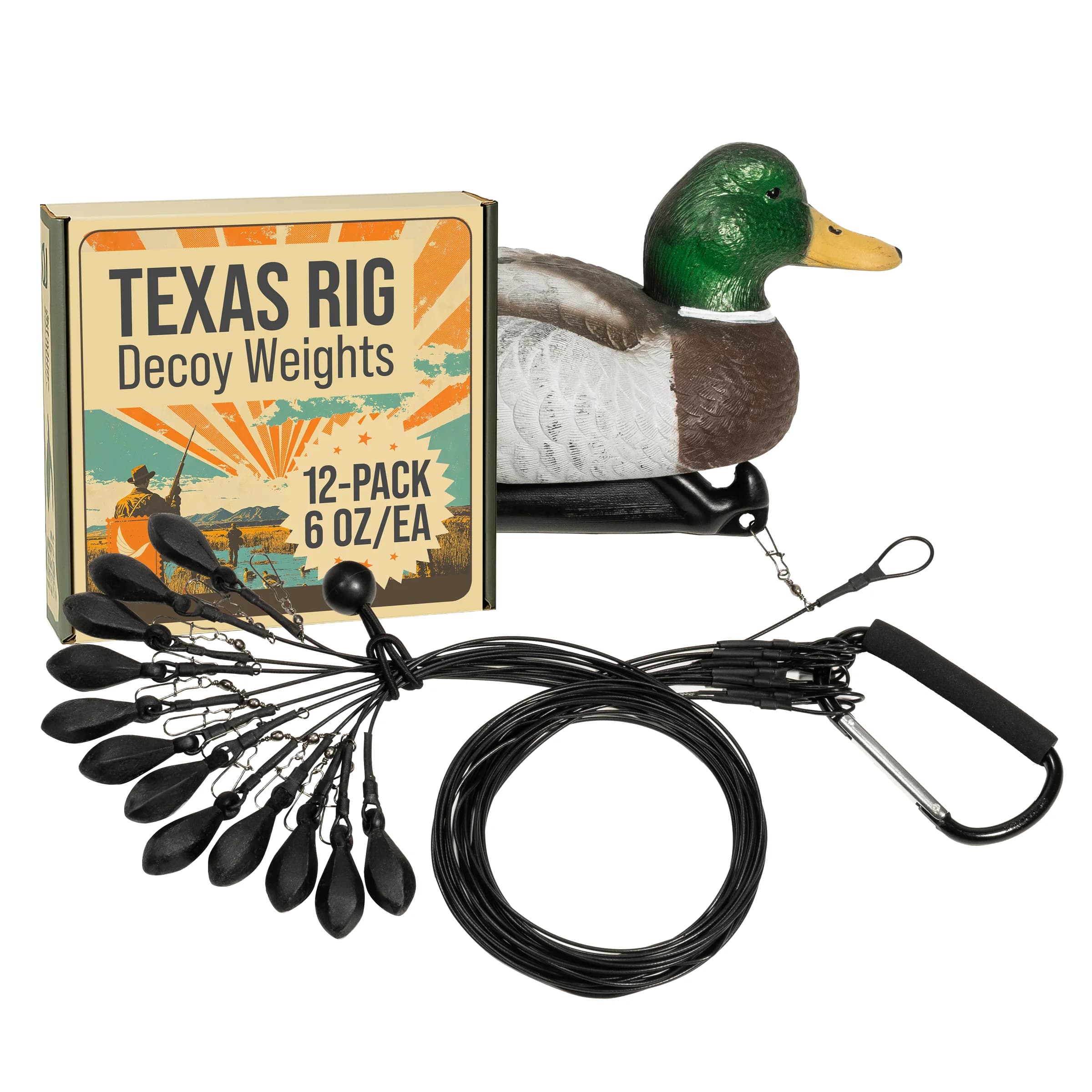
The 6 oz 12-pack includes a cushioned carabiner and bungee ball. Decoys and a decoy bag are not included. Check its listed contents and photos before choosing how to carry your spread.
Sources and limits
Cleaning principles are linked to the federal guidance above. The pickup and organization checklist is practical planning guidance, not a measured time-saving claim. The 4.5 lb figure is twelve anchors multiplied by 6 oz and divided by 16.
For your next setup
Lirben Texas Rig Decoy Weights - 6 oz (12-Pack)
Twelve individual rigs. Choose the fit for your water.