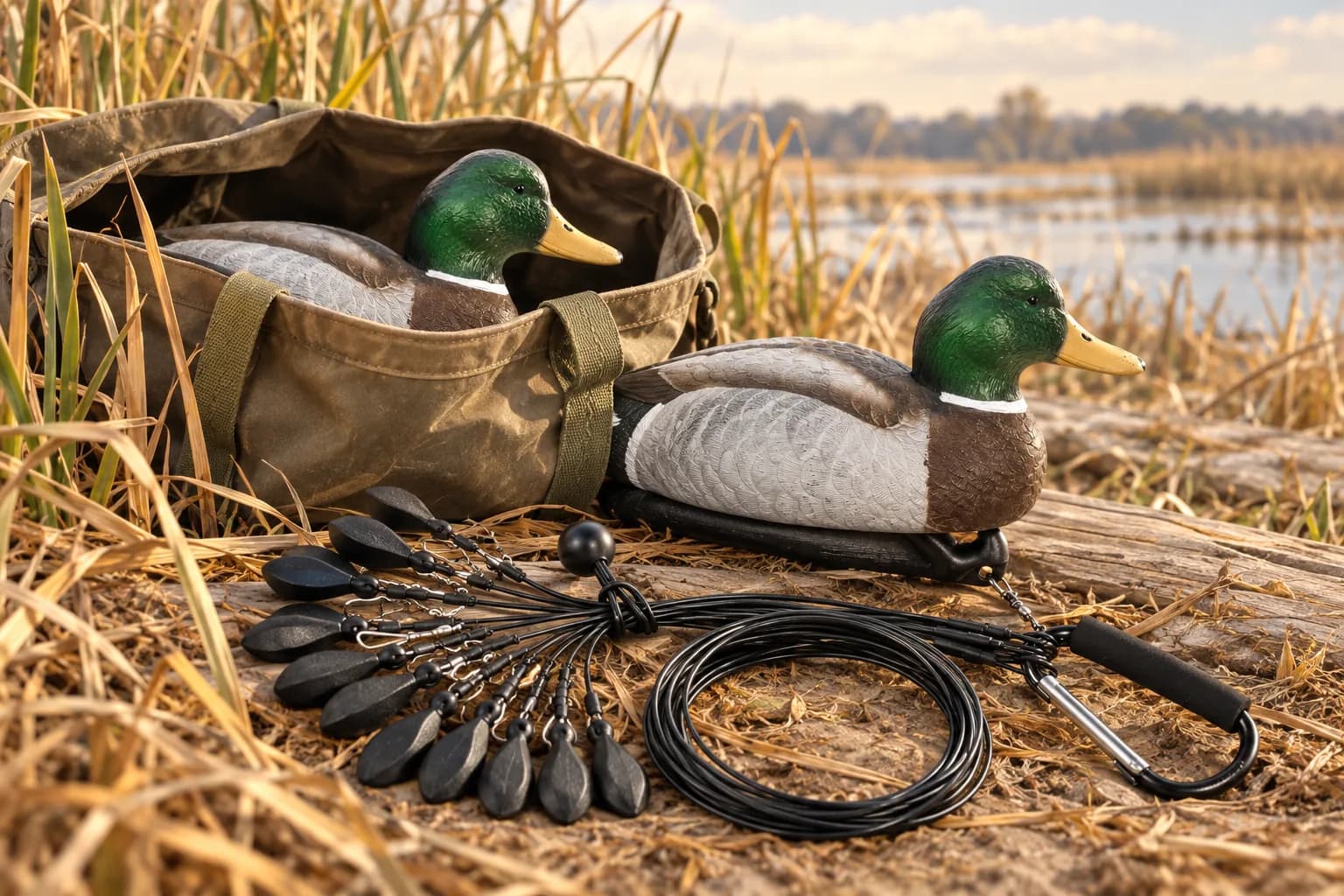
A useful walk-in decoy load is one you can carry over the full route, deploy without loose line underfoot, and bring back when the gear is wet. Start with the access and return trip. Weigh complete decoys, rigs and bags together before deciding how many to take.
Lead image: AI-generated editorial illustration based on Lirben product photos. Refer to the product listing for exact appearance and supplied contents.
Check the route before packing
Step 1
Check the whole route
Consider gates, footing, banks and the return trip before choosing a load.
Review the route in daylight where possible. Note gates, narrow paths, uneven ground, steep banks and the places where a cart or sled cannot pass. Plan how you will reach and recover each decoy from safe access.
A bag that carries comfortably from the garage to the vehicle may handle differently on a long muddy approach. Consider where its width catches vegetation, whether the load swings when you turn, and whether your hands remain available for the walking equipment you need. Do not set a target load from someone else's decoy count.
Ducks Unlimited's Hunting Light article emphasizes compact equipment and carrying only what the trip needs. Its specific older product examples are not a current shopping list. The useful principle is to evaluate bulk and the complete carried load, rather than anchors alone.
Decide the appropriate spread size with the decoy-count planning guide. This page handles getting that chosen spread to the water and back.
Weigh decoys, rigs and bags together
Step 2
Weigh the complete load
Use anchor arithmetic to compare options, then weigh the assembled bags.
Assemble the actual equipment in its intended bags. Weigh each loaded bag, then add the other equipment you will carry. Write down the total and check how the load feels on a short practice walk over comparable ground.
Anchor weight is one part of the budget. The following examples are calculated dry anchor-only weights at 6 oz each. They exclude line, hardware, decoy bodies, bags, clothing and other equipment.
6 decoys with 6 individual anchors
- Dry anchors only
- 2.25 lb
- What the figure leaves out
- Every decoy body, cable, swivel and carrying accessory
12 decoys with 12 individual anchors
- Dry anchors only
- 4.5 lb
- What the figure leaves out
- The loaded bag and all other equipment
18 decoys with 18 individual anchors
- Dry anchors only
- 6.75 lb
- What the figure leaves out
- Additional bags and the wet return load
24 decoys with 24 individual anchors
- Dry anchors only
- 9 lb
- What the figure leaves out
- The rest of the full carried load
| Feature | Dry anchors only | What the figure leaves out |
|---|---|---|
| 6 decoys with 6 individual anchors | 2.25 lb | Every decoy body, cable, swivel and carrying accessory |
| 12 decoys with 12 individual anchors | 4.5 lb | The loaded bag and all other equipment |
| 18 decoys with 18 individual anchors | 6.75 lb | Additional bags and the wet return load |
| 24 decoys with 24 individual anchors | 9 lb | The rest of the full carried load |
The calculation is anchor count multiplied by 6 oz, divided by 16. These are examples, not recommended spread sizes or measured product shipping weights.
Make a simple load note with these fields: decoy count, rig count, each complete loaded bag's measured weight, other carried equipment, and the planned pickup route. Include the actual bag and carrying accessories on the scale. This gives you a repeatable comparison when you change bodies, anchors or bags.
Reducing twelve 6 oz anchors to six removes 2.25 lb of anchors and the weight of six decoys and their hardware. Changing to a lighter anchor only makes sense if the replacement holds at the intended site. Use the anchor-size guide to evaluate that choice. Carrying an inadequate rig creates a retrieval problem rather than a useful saving.
Choose a carry method and separate rigs
Step 3
Pack controlled groups
Contain anchors and loose line, and choose a method that works on the actual route.
Group rigs of similar length, contain the anchors, and secure loose cable loops. Load the bag so it closes or retains its contents as intended. Check straps and connectors before putting the bag on.
Ducks Unlimited's transport guidance describes mesh bags, protective slotted bags, carts and sleds as different options. Route access and handling determine which is practical.
Backpack or shoulder bag
- Useful role
- Keeps a compact spread together during the approach
- Route check
- Check strap fit, movement and balance while fully loaded
Slotted decoy bag
- Useful role
- Separates bodies and protects their finish
- Route check
- Check the bag's width and keep lines from crossing slots
Cart
- Useful role
- Transfers some carrying work to wheels on a suitable route
- Route check
- Confirm the path, gates and surface suit it and that access allows it
Sled
- Useful role
- Contains a bag while being pulled on suitable ground
- Route check
- Check drag, obstacles and where you will unload at the bank
| Feature | Useful role | Route check |
|---|---|---|
| Backpack or shoulder bag | Keeps a compact spread together during the approach | Check strap fit, movement and balance while fully loaded |
| Slotted decoy bag | Separates bodies and protects their finish | Check the bag's width and keep lines from crossing slots |
| Cart | Transfers some carrying work to wheels on a suitable route | Confirm the path, gates and surface suit it and that access allows it |
| Sled | Contains a bag while being pulled on suitable ground | Check drag, obstacles and where you will unload at the bank |
Keep anchors from striking painted bodies and from swinging beside your legs. A carrying carabiner gathers loops; it does not make an unlimited load comfortable. The supplied Lirben carabiner is a gear accessory, not climbing or personal-safety equipment.
Separate a tangled rig before adding it to the group. Follow the storage and transport workflow for pickup and bundling. A mixed pile of long and short lines is harder to sort at the water.
Plan the return before you leave
Step 4
Rehearse pickup and return
Leave capacity for wet equipment and organize retrieval while placing the spread.
Leave room for wet bags and recovered equipment. During deployment, keep count of the rigs placed and preserve a practical pickup route. At retrieval, contain one cleared rig before gathering another.
The return can be the harder part of the trip. You may be tired, the ground may have changed, and wet gear may carry water or mud. Do not assume that an outbound load at your limit leaves enough capacity for recovery.
If the complete practice load is awkward, change the plan before leaving. Take a smaller suitable spread, divide equipment between partners, choose another access, or use an appropriate carrying aid. Avoid a plan that depends on leaving gear behind or entering unsafe water.
More trips can be an option only when the access, available time and return conditions support the whole plan. Work out where each contained group will wait and how every group will be recovered. Do not assume a second wet trip will be as easy as the first approach.
Remove aquatic material and drain equipment before transport. Continue with rig maintenance for cleaning, drying and inspection before the next waterbody.
Where the Lirben set fits
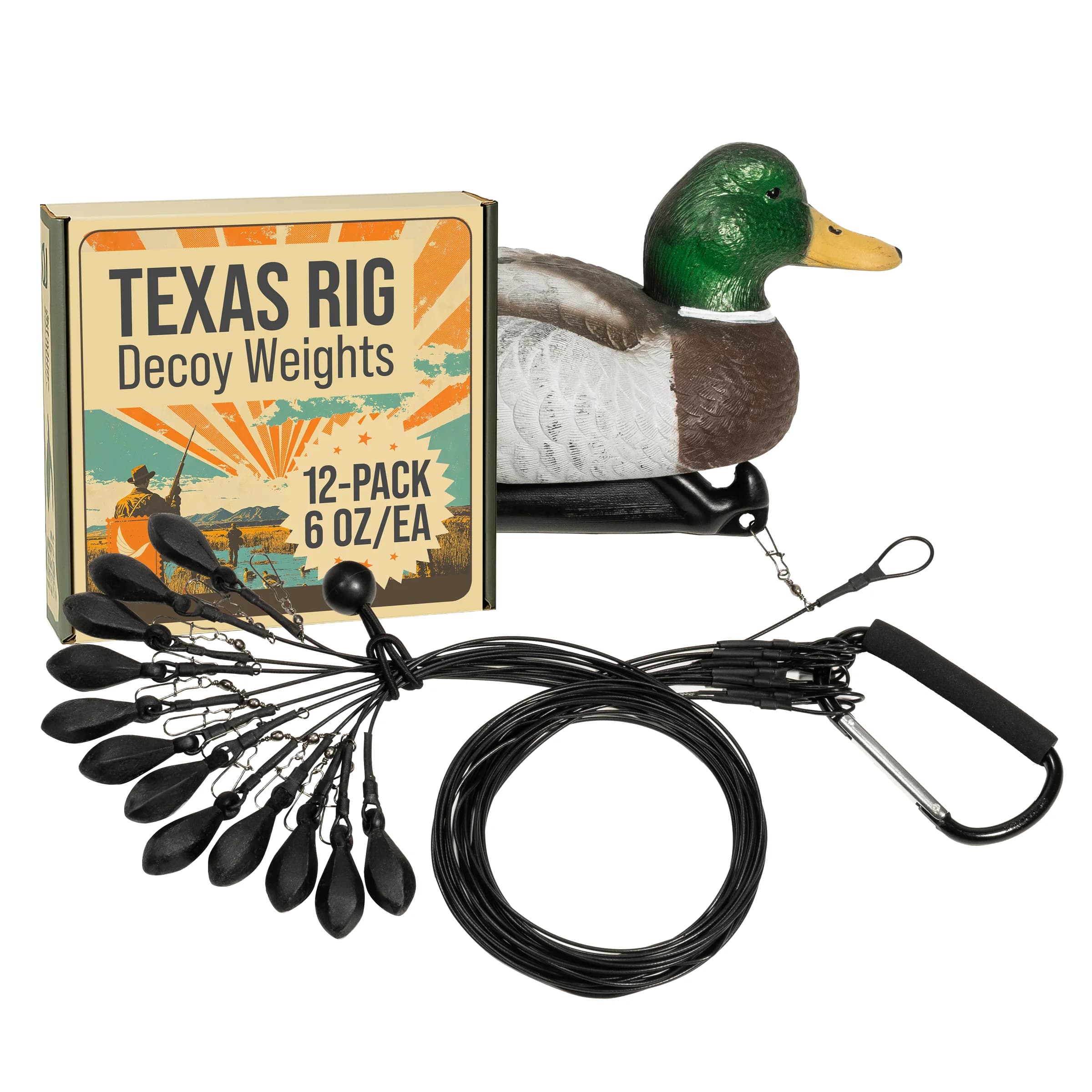
The Lirben 6 oz 12-pack provides twelve individual rigs on 48-inch PVC-coated steel cable, with a cushioned carabiner and bungee ball. The catalog positions them for shallow water up to 3 ft. The anchors alone total 4.5 lb; the complete kit and decoys weigh more.
A twelve-rig package does not require carrying twelve decoys on every outing. Match the number carried and the line reach to the actual plan. For arranging the set after arrival, use the small-spread layout guide.
Common questions
Is there a safe maximum decoy-bag weight for everyone?
No single number fits every person and route. Evaluate the complete load, your abilities, footing and return conditions. A bag's stated capacity is not a personal carrying recommendation.
Should I use lighter anchors for a long walk?
Only when they still hold the decoys at the intended site. A smaller spread with suitable rigs can be more practical than a larger spread with inadequate anchors.
Will lighter decoy bodies remove the anchor load?
They reduce the body portion of the load. Twelve unchanged 6 oz anchors still weigh 4.5 lb before their cables and hardware, whichever decoy bodies you choose. Weigh the complete replacement setup rather than assuming lighter bodies solve every carrying problem.
Should I carry the rigs loose on a carabiner?
Use the maker's carrying arrangement and control the anchors and lines. Check the route and the size of the group. A bag may help contain the bundle, but it still needs organization.
Sources and limits
The linked Ducks Unlimited articles support the emphasis on portability and the different transport methods. Weight examples are arithmetic from the stated anchor size. Route checks and packing decisions are planning guidance, not a physical-fitness assessment or a claim of measured carrying performance.
For your next setup
Lirben Texas Rig Decoy Weights - 6 oz (12-Pack)
Twelve individual rigs. Choose the fit for your water.