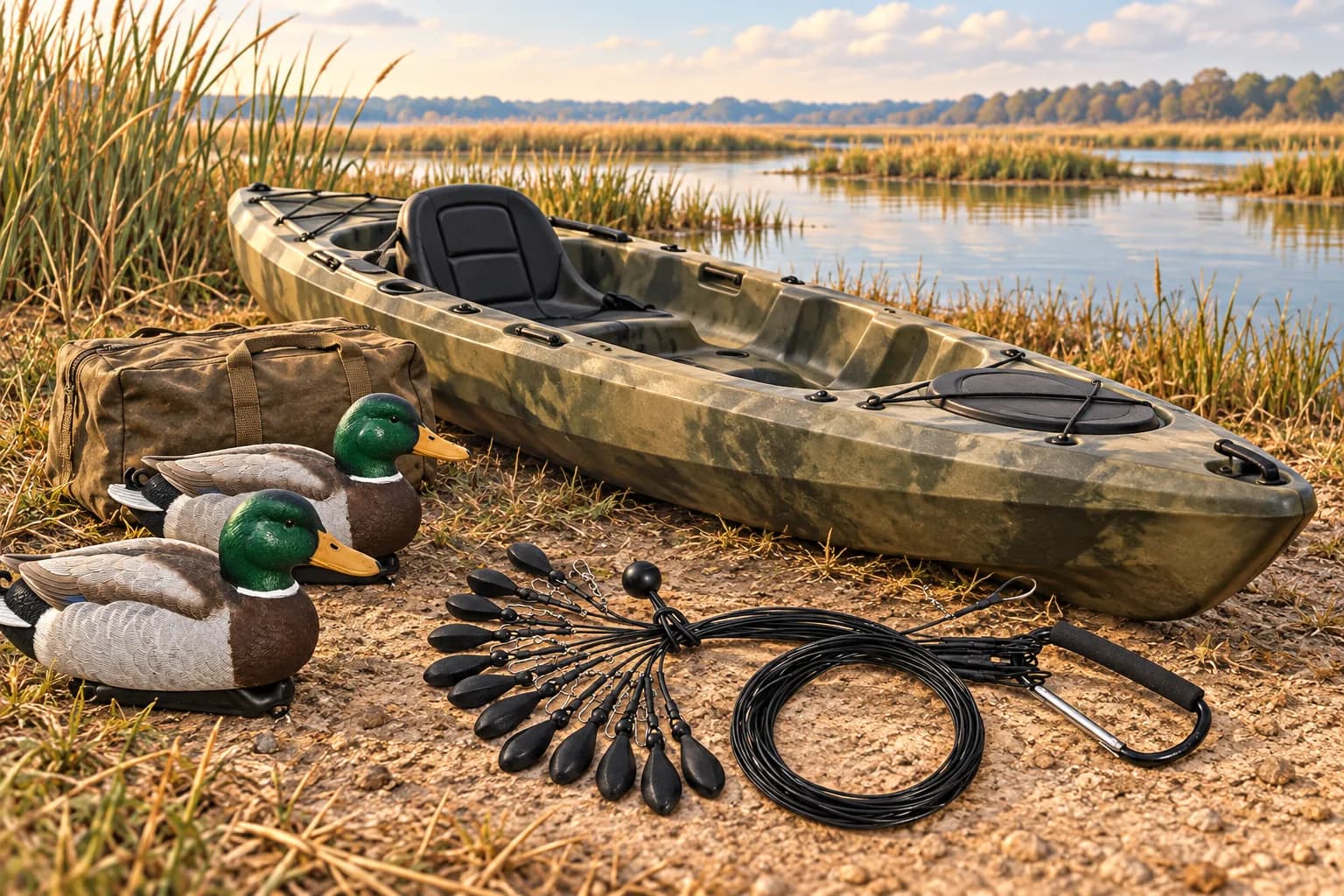
Build a kayak decoy setup around the boat's usable load and the way you will recover the spread. Keep decoys in contained, accessible groups, keep anchor lines out of paddles and foot space, and leave room for wet gear on the return. A decoy rig anchors a decoy; it is not a kayak anchoring system.
Lead image: AI-generated editorial illustration based on Lirben product photos. Refer to the product listing for exact appearance and supplied contents.
Check usable capacity and the route
Step 1
Check boat capacity and access
Use the exact kayak maker's limits and include people, equipment and the return load.
Read the exact kayak model's manual and capacity definitions. Account for the paddler, clothing, safety equipment and every other carried item. Assess launch, landing, weather and recovery access before choosing a decoy load.
Do not use a generic number of decoys as a boat-capacity rule. A dozen small duck floaters and a dozen large goose floaters differ in both weight and bulk. Even a load below a published weight limit may be awkward to reach or may obstruct the cockpit.
Old Town publishes separate total and usable capacity figures for its boats. That is a reason to read the labels and the model instructions carefully. Do not assume another manufacturer defines capacity the same way, or subtract the same equipment twice.
Count all of the equipment you actually add. Keep a written load list and weigh loaded bags. For twelve 6 oz decoy rigs, dry anchors alone weigh 4.5 lb. Cable, hardware, decoys, the bag and other equipment are additional. That arithmetic does not establish how much your kayak should carry.
Old Town's kayak duck-hunting guidance stresses wearing a lifejacket and cautions that a heavily loaded kayak handles less readily. Use suitable paddling equipment and conditions for your abilities. Reduce or abandon the load if the launch or recovery plan is doubtful.
Pack for balance and clear access
Step 2
Contain the decoys and rigging
Keep anchors and loops contained while preserving paddling and exit space.
Arrange loaded bags and anchors in the kayak's intended storage areas using the maker's guidance. Keep the load contained and test your paddling movement, foot space and access while on land before launching.
Plan where the first rig comes from and where the last recovered rig will go. Avoid reaching far behind you for an anchor hidden underneath the entire bag. An accessible small group can be easier to manage than a loose stack of decoys over the deck.
Decoy bodies
- Packing objective
- Fit within the available storage
- Check before launch
- The bag stays contained and does not block paddling or exit
Weights and rig loops
- Packing objective
- Prevent loose metal and cable on deck
- Check before launch
- No loop can fall into the footwell or propulsion area
First-to-deploy group
- Packing objective
- Reach it without an unstable stretch
- Check before launch
- Practice the reach with the boat on land
Recovered equipment
- Packing objective
- Have a defined place for wet rigs
- Check before launch
- The bag still contains the load after pickup
| Feature | Packing objective | Check before launch |
|---|---|---|
| Decoy bodies | Fit within the available storage | The bag stays contained and does not block paddling or exit |
| Weights and rig loops | Prevent loose metal and cable on deck | No loop can fall into the footwell or propulsion area |
| First-to-deploy group | Reach it without an unstable stretch | Practice the reach with the boat on land |
| Recovered equipment | Have a defined place for wet rigs | The bag still contains the load after pickup |
Secure gear with the boat's intended arrangement while keeping release and exit routes clear. Do not tether decoy lines around your body, PFD or legs. Do not improvise a permanent connection between a loose decoy bundle and the moving boat.
The storage and transport guide covers separating loops and controlling weights. The walk-in load guide covers the separate trip between the vehicle and launch.
Deploy from stable access
Step 3
Deploy one controlled rig
Work from a stable position, clear each line and verify hold before adding more decoys.
Whenever the site allows it, organize the group from a stable bank or landing. If working from the kayak, use only a position and method that you can manage safely. Clear one rig, place it without crossing another line, and contain the remaining rigs.
Keep lines away from the paddle, pedal drive, rudder and feet. Do not throw a tangled group and expect it to separate. If deployment requires leaning beyond a stable position or entering unsuitable water, change the access or layout.
At each placement, check that the anchor reaches bottom and the decoy floats freely. A kayak may let you reach deeper water than the rig can use. The line-length guide explains why nominal line length is not a maximum water-depth rating.
Once a rig settles, watch its position against a shoreline reference. A decoy can swing around a holding anchor. Continued relocation calls for investigation, not towing the next decoy into place behind it. Use the troubleshooting guide to distinguish inadequate reach, attachment faults and anchor drag.
For larger or deep-water sets, a longline system is a different equipment and handling choice. Do not turn twelve independent rigs into a shared mainline by clipping them together.
Retrieve with the return load in mind
Step 4
Retrieve and contain each rig
Recover one decoy and anchor at a time and keep loose line away from propulsion and feet.
Recover one decoy and its anchor, clear the line, then place the whole rig in its intended group. Keep that group contained before moving to another decoy. Monitor how the growing load affects access and handling.
Never drag a set of weighted rigs behind the kayak as a transport shortcut. Avoid wrapping line around a hand or pulling against a snag from an unstable position. Plan a way to retrieve each placement before deploying it; do not pursue drifting equipment into unsafe conditions.
Return with equipment contained rather than piled around the seat. Leave space for wet gear and any other carried items. After landing, remove aquatic material, drain the kayak and gear, and follow the maintenance workflow before moving between waters.
Is the Lirben kit suitable for a kayak spread?
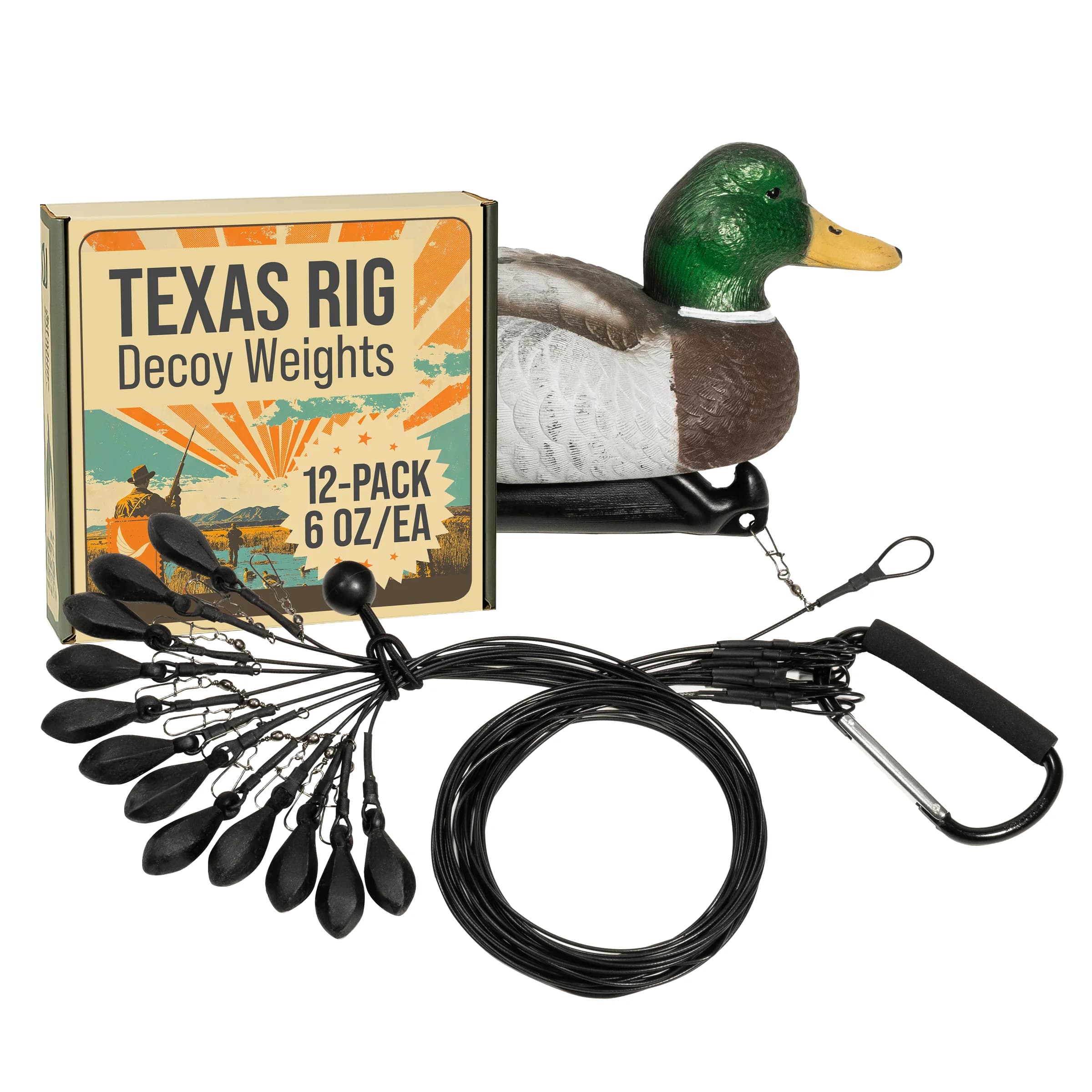
The Lirben 6 oz 12-pack can serve as individually anchored decoy rigs when the measured water, decoy fit and holding conditions suit its fixed specifications. It uses 48-inch PVC-coated steel cable and is cataloged for shallow water up to 3 ft. A kayak does not extend that depth range.
The cushioned carabiner and bungee ball help organize the gear. They are not boat fittings or personal-safety devices. Choose your decoy count and small-spread layout around what you can safely carry, deploy and retrieve.
Common questions
How many decoys fit in a kayak?
There is no universal count. Check the exact hull's usable capacity, storage dimensions, your full load and whether you can reach and contain each group.
Can I anchor the kayak with a decoy weight?
Use equipment and instructions intended for the boat. A decoy anchor kit has no kayak holding or personal-safety rating.
Can I deploy decoys while drifting?
Choose a controlled, stable method appropriate to the site and your abilities. Uncontrolled drift makes line and placement management harder. Use stable access where available and change the plan when conditions prevent it.
Sources and limits
Old Town's manufacturer guidance supports capacity interpretation, storage planning and basic loaded-kayak cautions. The retrieval sequence is conservative planning guidance, not a substitute for kayak instruction or a claim that one hull or rig fits every site. Product dimensions come from Lirben's catalog.
For your next setup
Lirben Texas Rig Decoy Weights - 6 oz (12-Pack)
Twelve individual rigs. Choose the fit for your water.