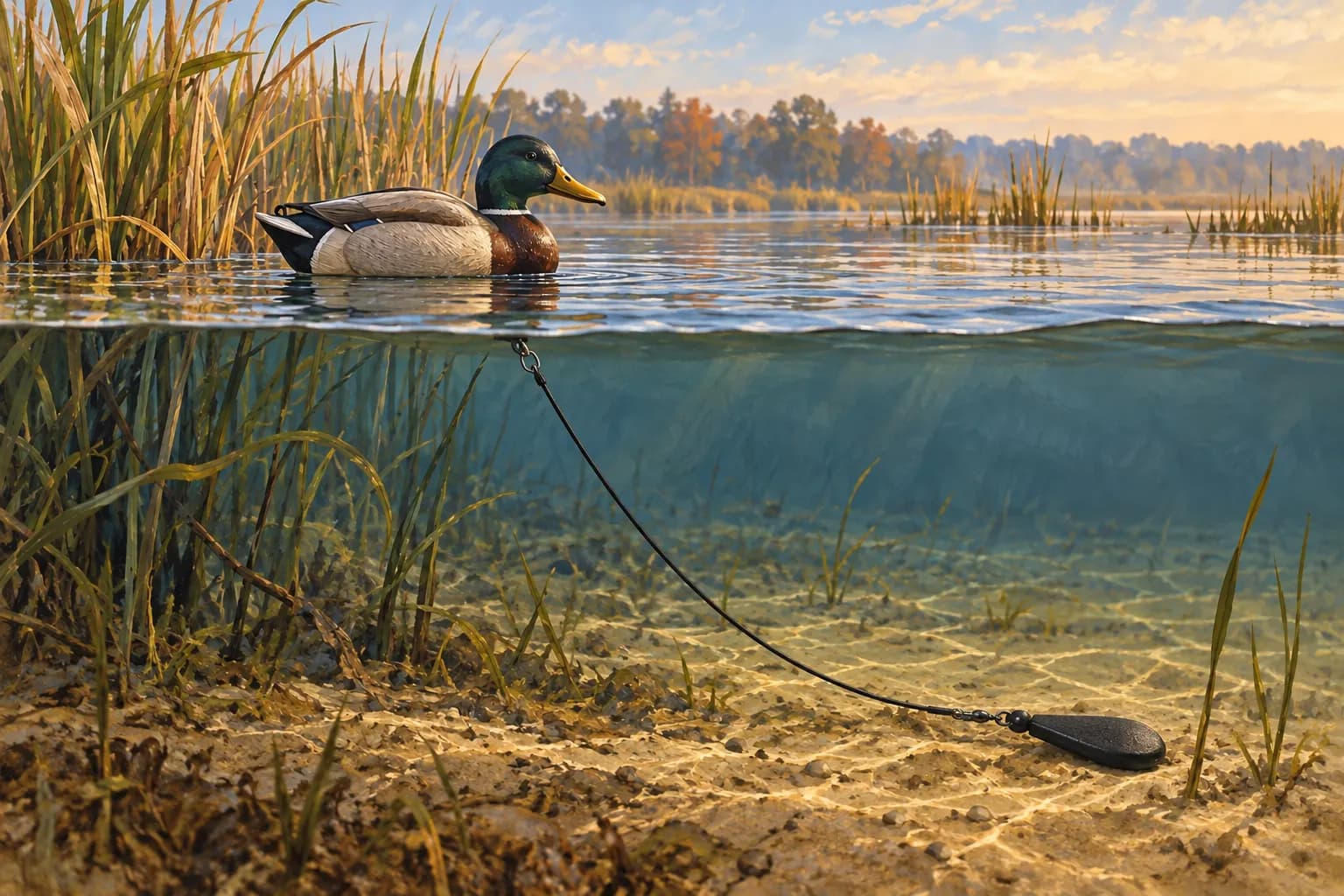
Decoy line must reach the bottom with room for the decoy to float and move. Choose a finished rig longer than the maximum depth you expect to use, then check it in place. Equal line length and water depth leave little room for connections, changing water levels or sideways movement.
Lead image: AI-generated editorial illustration based on Lirben product photos. Refer to the product listing for exact appearance and supplied contents.
Measure the water you will use
Step 1
Check the deepest placement
Plan for the deepest point and likely water-level change in your actual spread.
Check the intended placements from a safe position. Do not assume that a pond's edge represents the whole set. Account for a drop-off, changing water level and the route you will use to retrieve the decoys.
North Dakota Game and Fish recommends line slightly longer than the maximum planned water depth. The useful principle is extra reach. It does not establish one multiplier that works for every rig, bottom and current.
If you know only the average depth, leave the deeper placements out until you can verify them safely. In tidal or changing water, evaluate the expected range during the whole outing. A rig that starts with slack can pull tight as water rises.
Check usable line length
Step 2
Measure usable reach
Compare the finished connection-to-anchor reach with the water depth, allowing movement.
Lay out the finished rig without stretching or forcing it. Measure the reach available between the decoy connection and anchor. Loops, crimps, fixed stops and the attachment route can change how much of a nominal cable length is usable.
For a DIY rig, the cut length is not the finished reach. Allow for both terminal loops and any other assembly requirements. Follow the line and hardware supplier's directions; do not apply one crimp allowance to every cable diameter. See line and hardware selection.
A finished-reach example, not a depth rating
Suppose a hypothetical finished rig measures 40 inches from its anchor connection to its decoy connection. In 24 inches of water, subtracting depth leaves a 16-inch vertical difference. If the deepest placement later becomes 36 inches, that difference is only 4 inches. These are illustrative measurements, not the measured reach of the Lirben kit.
Neither result is a horizontal swing allowance: an angled line spans less vertical depth, and the attachment position, waves and water-level changes also matter. Do not convert that arithmetic into a guarantee that either placement fits. Use it to identify where a free-floating, in-place check or a longer rig is needed.
Why 48 inches does not mean 4 feet of water
Forty-eight inches equals four feet as a unit conversion. On a decoy rig, that measurement alone is not a working-depth rating. The line needs room for its connections and for the decoy's movement. Lirben's 48-inch set is listed for water up to 3 ft deep, subject to conditions and an in-place check.
Fixed overall length also does not mean a fixed anchor connection. The fixed-versus-sliding guide separates those design questions.
Sheltered shallow pond
- What to check
- Bottom contact and free floating at each placement
- Useful next step
- Use a suitable shallow-water rig, then watch it settle.
Depth near the rig's limit
- What to check
- Finished reach and room for water-level changes
- Useful next step
- Choose a longer appropriate rig or move shallower.
Deep open water
- What to check
- System choice, deployment and safe retrieval
- Useful next step
- Compare longer individual rigs with a purpose-built longline.
Moving water
- What to check
- Drift, line angle and the anchor's actual hold
- Useful next step
- Evaluate the whole rig and placement; do not just shorten the line.
| Feature | What to check | Useful next step |
|---|---|---|
| Sheltered shallow pond | Bottom contact and free floating at each placement | Use a suitable shallow-water rig, then watch it settle. |
| Depth near the rig's limit | Finished reach and room for water-level changes | Choose a longer appropriate rig or move shallower. |
| Deep open water | System choice, deployment and safe retrieval | Compare longer individual rigs with a purpose-built longline. |
| Moving water | Drift, line angle and the anchor's actual hold | Evaluate the whole rig and placement; do not just shorten the line. |
Check the rig on the water
Step 3
Observe the decoy
Confirm that the anchor stays on bottom and the decoy floats freely.
From safe access, lower the anchor and allow the decoy to settle. Look for a level floating posture, free movement and a stable position against a fixed reference. Recheck after water or weather changes.
A tipped decoy can mean a taut or snagged line, an attachment problem or a decoy issue. A decoy sweeping a wide area can have more slack than the chosen spacing allows. Diagnose the cause before cutting line. Shortening a rig that barely reaches the bottom makes the depth problem worse.
An anchor that drags may need a different weight or shape, or a less exposed location. Use the anchor-size decision guide alongside this length check. A heavier anchor cannot compensate for insufficient reach.
When is a longer individual rig the wrong answer?
Longer rigs add loose line to handle during pickup and transport. If most placements are deep, compare the whole workflow with a wrap rig or longline. Ducks Unlimited describes gang rigs as a main line with short decoy leaders, often used for deep, open water in its Rigging Rundown.
For a few shallow decoys beside a deeper set, different systems may serve different placements. Keep their lines separate. Avoid improvising extensions or attachment changes unless the component manufacturer supports the method. For moving water, use the river anchoring guide.
The longline setup guide covers the main line, short droppers and recovery sequence in depth. For tidal placements, use the whole-outing water-level and access checklist as well as the current at the moment you deploy.
Common questions
Can I shorten a pre-rigged cable?
Only rebuild a cable if you have suitable replacement hardware, the correct tool and assembly instructions for that material. Cutting a factory rig changes its finished assembly. If you need adjustable depth, compare systems designed for it rather than treating a fixed cable as adjustable.
Will a longer line stop drift?
It can help when inadequate reach is the cause, but it will not fix every anchor or bottom problem. Added slack also changes the area a decoy can move through. Check spacing and hold together.
Which Lirben rig should I choose for deep water?
Lirben currently lists one 6 oz, 48-inch rig. It is a shallow-water option. If your water exceeds its suitable depth, choose a different length or system rather than forcing this set to fit.
Return to the complete rigging guide for assembly and deployment, then group rigs by length using the storage guide.
Sources and limits
The state-agency source supports the extra-reach principle; Ducks Unlimited supports the longline system description. The examples here are planning checks, not a tested line-length formula. Product dimensions come from Lirben's catalog.
For your next setup
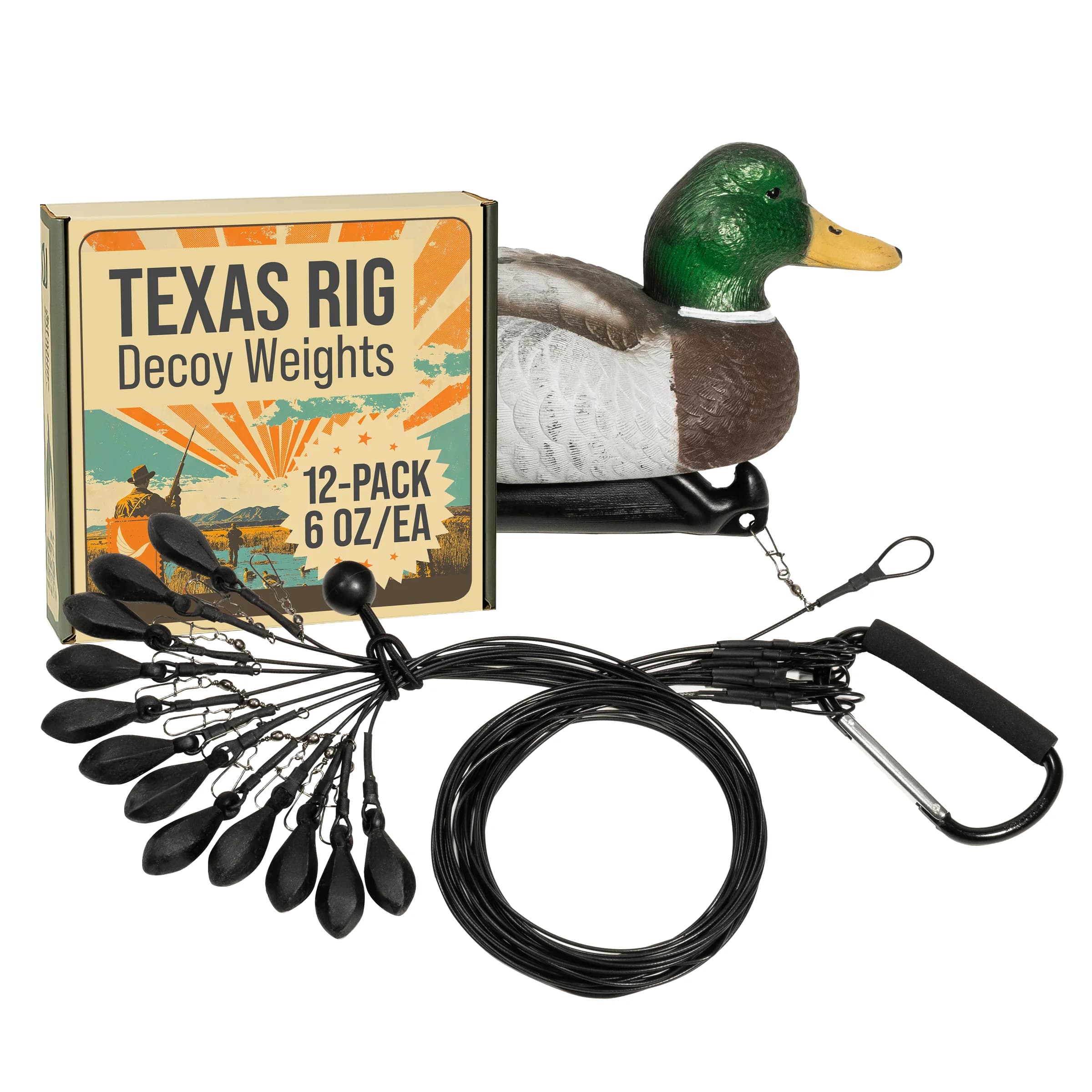
Lirben Texas Rig Decoy Weights - 6 oz (12-Pack)
Twelve individual rigs. Choose the fit for your water.