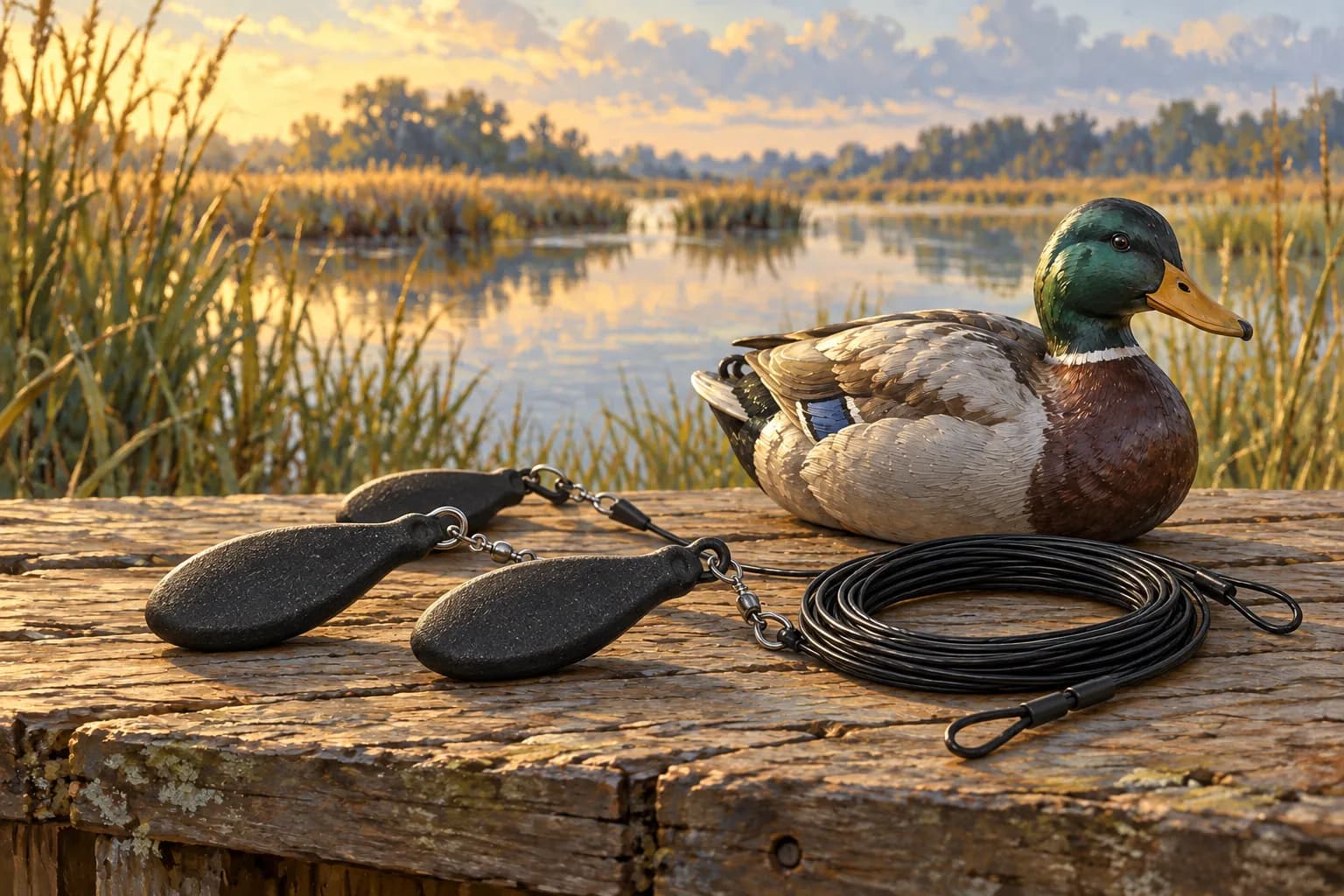
Choose duck decoy weights by the water you hunt, the bottom they must grip and the load you can carry. A 6 oz anchor is one option for shallow-water rigs; a heavier anchor adds carrying weight without guaranteeing a secure hold. Check line length, decoy size and actual drift alongside anchor size.
Lead image: AI-generated editorial illustration based on Lirben product photos. Refer to the product listing for exact appearance and supplied contents.
Start with conditions, not a wind-speed chart
Step 1
Read the water and bottom
Start with depth, exposure, bottom type and the decoy you need to hold.
Note the deepest part of the set, whether the bottom is firm or soft, and whether the water is sheltered or exposed. A light duck decoy and a large goose floater do not present the same surface to wind and moving water.
North Dakota Game and Fish's beginner water-hunting guide distinguishes lighter anchors for small, shallow ponds from heavier options for large, deep water. That is a useful starting distinction, not a universal ounce recommendation.
No weight can be assigned a dependable wind-speed limit without considering the full rig and site. An anchor that holds in mud can slide across another bottom. A line that pulls tight can lift or drag an otherwise adequate weight. Read the line-length guide before treating more ounces as the only fix.
Compare 4, 6 and 8 oz without guessing holding power
Anchor shape is a separate decision from ounce weight. The anchor-shape and bottom comparison explains bank, strap, mushroom and other designs, and distinguishes external anchors from ballast inside a decoy's keel.
Step 2
Compare the carry load
Calculate the anchor weight for your actual decoy count before buying.
Multiply decoy count by anchor weight, then divide ounces by 16 to get pounds. The examples below include anchors only. Cable, hardware, decoys and bags add to the load.
4 oz each
- 12 anchors
- 3 lb
- 24 anchors
- 6 lb
- Decision to consider
- Less carry weight; confirm adequate hold at your site.
6 oz each
- 12 anchors
- 4.5 lb
- 24 anchors
- 9 lb
- Decision to consider
- A middle carry load; check both depth and exposure.
8 oz each
- 12 anchors
- 6 lb
- 24 anchors
- 12 lb
- Decision to consider
- More load to carry; still requires a suitable anchor shape and line.
| Feature | 12 anchors | 24 anchors | Decision to consider |
|---|---|---|---|
| 4 oz each | 3 lb | 6 lb | Less carry weight; confirm adequate hold at your site. |
| 6 oz each | 4.5 lb | 9 lb | A middle carry load; check both depth and exposure. |
| 8 oz each | 6 lb | 12 lb | More load to carry; still requires a suitable anchor shape and line. |
These are arithmetic comparisons, not test results. Moving a dozen rigs from 6 oz to 8 oz adds 1.5 lb of anchors. If only a few exposed placements need another setup, carrying different clearly separated groups may be more practical than changing every decoy. Each individual Texas rig still holds only its own decoy.
Does anchor shape matter?
Yes. A bank weight, strap weight and purpose-built bottom-gripping anchor interact differently with the bottom and store differently on the decoy. Compare the attachment, retrieval method and storage fit as well as the ounce label. Our rig-system comparison explains where a wrap rig or longline may be a better choice.
Check hold before adding decoys
Step 3
Check each rig in place
Watch whether each anchor stays put and the decoy floats without pulling tight.
Set one rig where you can safely observe and retrieve it. Let the weight reach bottom. Watch the decoy against a fixed shoreline reference, then check again after the line settles and conditions change. Use a safe access point throughout.
If it moves steadily away, inspect the likely cause:
- A taut line or tipped decoy points to insufficient usable length or an obstructed connection.
- An anchor that slides after settling calls for a different weight, shape or placement.
- A decoy that stays in place while nearby rigs drift shows why each rig needs its own check.
- Repeated movement across the whole set may be a reason to choose more sheltered water or another rig system.
For specific conditions, continue to windy-water setup or current and river anchoring. Do not enter unsafe water to recover or test an anchor.
Where the Lirben 6 oz set fits
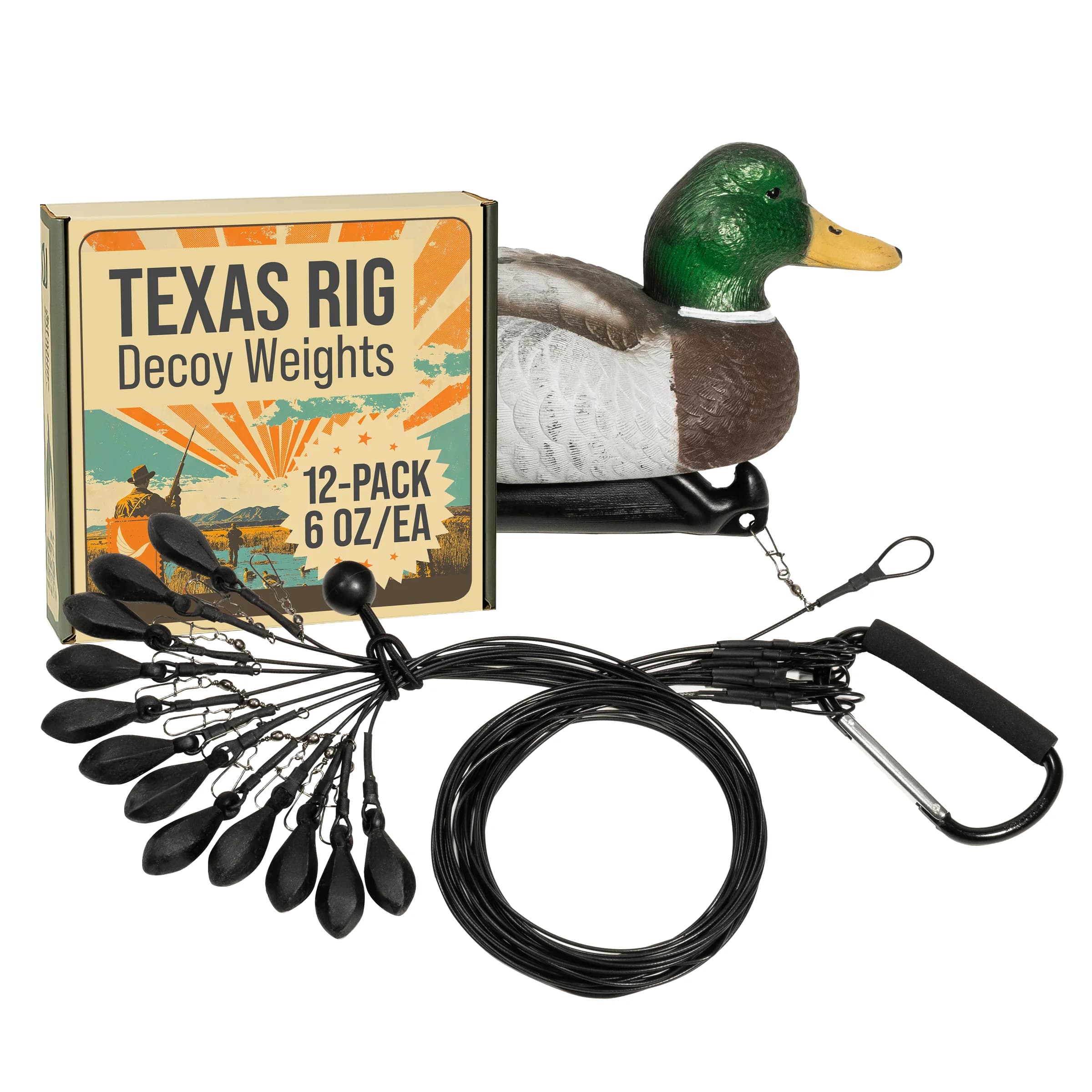
The Lirben 12-pack contains twelve pre-rigged 6 oz bank weights on 48-inch PVC-coated steel cable. The catalog positions it for shallow water, with a listed depth range up to 3 ft, and duck or light goose decoys. It includes stainless swivels, aluminum crimps, a cushioned carabiner and a bungee ball.
Choose it when those dimensions suit the planned set. A 48-inch cable is not a promise of working in 4 ft of water, and a larger weight would not make that cable longer. For deep or fast water, evaluate a different length or anchoring system. Lirben's current catalog does not offer 4 or 8 oz variants.
Common questions
Are 6 oz weights always better than 4 oz?
No. The right choice holds the decoy at that site and fits your carrying plan. More weight costs more effort to transport. Less weight is useful only if the rig still holds.
How many anchors do I need?
An individually anchored spread needs one rig per decoy. Twelve decoys use twelve rigs; eighteen decoys need eighteen. A 12-pack is a quantity, not a recommended spread size or a guarantee of hunting success.
Should I mix anchor weights?
You can keep different rigs for different placements, provided you can identify and separate them during deployment. Use the storage and transport workflow to avoid mixing long, short and heavier rigs in one loose bundle.
Return to the complete decoy-rigging guide for the full setup sequence.
Sources and limits
The linked state-agency guide supports the broad shallow-versus-deep distinction. Product dimensions and contents come from Lirben's catalog. Carry loads are calculated from the stated ounce weights. This guide does not report comparative holding-power tests.
For your next setup
Lirben Texas Rig Decoy Weights - 6 oz (12-Pack)
Twelve individual rigs. Choose the fit for your water.