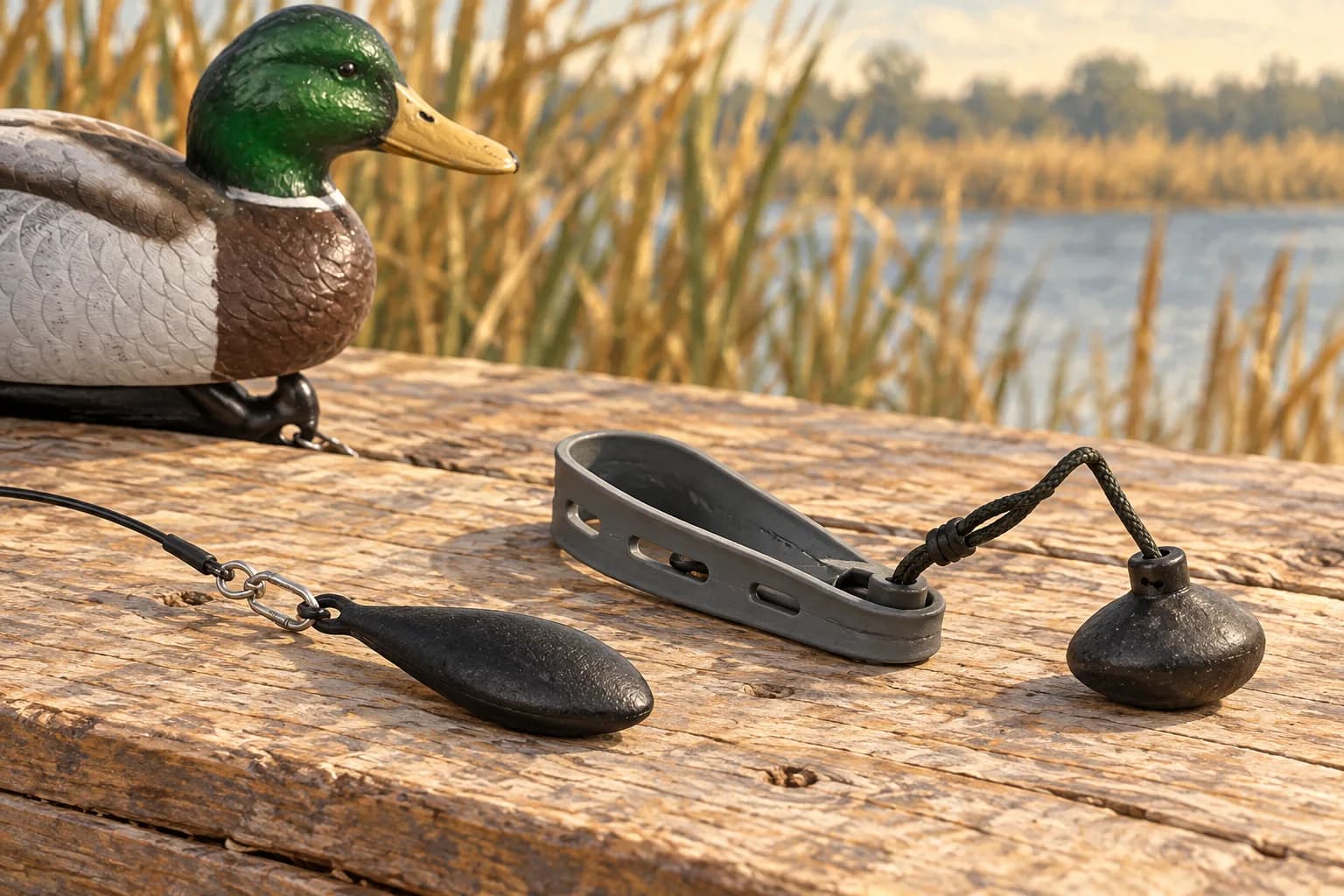
Decoy-anchor shape affects how the weight contacts the bottom, connects to the line and stores against the decoy. Bank weights, flexible straps, J-shaped keel weights and mushroom anchors solve those tasks differently. Equal ounce labels do not establish equal hold, and no shape works on every bottom.
Lead image: AI-generated editorial illustration based on Lirben product photos. Refer to the product listing for exact appearance and supplied contents. Alternative anchor shapes are illustrative comparisons, not items supplied in the Lirben kit.
A weighted keel is not an external anchor
Keel ballast helps a floating decoy sit or balance as its maker intends. An external anchor connects through a line and holds the decoy's position over the bottom. Those are different jobs. For example, Higdon describes a self-righting weighted keel on its goose feeder; that feature does not replace an external anchoring system.
Keel construction varies by model. Follow the maker's instructions for ballast, plugs and intended floating posture. Adding another external weight will not necessarily correct a damaged body, missing ballast or an unsuitable connection.
Compare the shape and its storage method
Step 1
Identify the shape and assembly
Look at the anchor body, connection and intended way to stow it.
Inspect the complete assembly, not just the outline of the weight. Identify the line attachment, any sliding path, and the intended storage arrangement. Confirm that it suits the line material and decoy.
Ducks Unlimited's component guide describes purpose-built anchors, including bendable strap weights, as part of a rig whose line and connections also matter. Shape selection is one decision inside that whole assembly.
Bank or teardrop weight
- Recognizable construction
- A compact weight body used in many individual rigs; Lirben's is flat and elongated
- Handling or storage check
- Check how the maker gathers the line and controls the weight during carrying
Strap weight
- Recognizable construction
- An elongated bendable strap in designs intended to wrap for storage
- Handling or storage check
- Use only the intended bend and storage method; keep it from scraping the finish
J or keel-grabber weight
- Recognizable construction
- A hooked body with a retaining arrangement in some designs
- Handling or storage check
- Check fit against the particular keel and the condition of its retaining cord
Mushroom weight
- Recognizable construction
- A broad rounded head with a stem; designs and stem lengths differ
- Handling or storage check
- Check bottom contact and the maker's method for stowing the body and line
| Feature | Recognizable construction | Handling or storage check |
|---|---|---|
| Bank or teardrop weight | A compact weight body used in many individual rigs; Lirben's is flat and elongated | Check how the maker gathers the line and controls the weight during carrying |
| Strap weight | An elongated bendable strap in designs intended to wrap for storage | Use only the intended bend and storage method; keep it from scraping the finish |
| J or keel-grabber weight | A hooked body with a retaining arrangement in some designs | Check fit against the particular keel and the condition of its retaining cord |
| Mushroom weight | A broad rounded head with a stem; designs and stem lengths differ | Check bottom contact and the maker's method for stowing the body and line |
Those are form and handling distinctions, not a ranking from worst to best.
Strap weights
H&H's strap-weight description explains that its straps are bendable and can secure wrapped decoy cord for storage. Other products use different coatings or retention methods. Do not bend a rigid bank weight or kink coated steel cable to imitate a strap rig.
A flexible storage method can be useful if you prefer wrapping each decoy. Compare that routine with gathering Texas-rig carrying loops in the rig-system guide.
J weights and keel grabbers
Banded's Keel Grabber uses a J-shaped body and a rubber retaining cord. Rig'Em Right's J-weight instructions likewise describe securing the weight to the keel after wrapping the line. These are examples of intended storage arrangements; they are not evidence that any hook fits every decoy.
Inspect the retaining part as well as the weight. A weight that stores neatly but hangs loose in transit can damage paint or catch another line.
Mushroom weights
Tanglefree describes its mushroom anchor as a rounded-profile bottom-gripping design. Rig'Em Right's long-stem version also has a stem intended to secure against a decoy for storage. A short rigid stem and a longer bendable stem should not be treated as the same carrying design.
Manufacturer performance descriptions apply to their own products. They do not establish a measured advantage over a Lirben bank weight on your water.
Match the check to the bottom
Step 2
Assess bottom contact
Distinguish actual bottom contact from vegetation, a ledge or a snag.
Assess the depth and bottom from safe access. Confirm the anchor can reach the actual bed rather than resting on vegetation or hanging against an obstruction. Recheck after the line settles.
Use the bottom description to choose what to observe, rather than assigning an untested winning shape.
For a specific design example, Do-it's decoy-anchor description identifies a mushroom form for soft bottoms and a pyramid form with less tendency to roll on hard bottoms. This is manufacturer guidance for those forms, not a comparative test of all decoy anchors. A pyramid is another alternative shape; it is not the flat bank weight supplied in the Lirben kit.
Soft mud or silt
- What to check
- Whether the anchor settles and whether you can retrieve it without unsafe force
- Reason to change the plan
- Progressive drag, buried hardware that cannot be recovered safely, or debris caught in the assembly
Firm sand or hard bottom
- What to check
- Whether the body slides or rolls as the line changes direction
- Reason to change the plan
- Continued movement after settling
Rock or uneven ledges
- What to check
- Whether the line and anchor clear edges and still reach the intended bed
- Reason to change the plan
- A trapped weight, abraded line or a placement requiring an unsafe recovery
Vegetation or submerged wood
- What to check
- Whether the weight reaches bottom and the line stays clear
- Reason to change the plan
- A suspended anchor, repeated snags or crossed lines
| Feature | What to check | Reason to change the plan |
|---|---|---|
| Soft mud or silt | Whether the anchor settles and whether you can retrieve it without unsafe force | Progressive drag, buried hardware that cannot be recovered safely, or debris caught in the assembly |
| Firm sand or hard bottom | Whether the body slides or rolls as the line changes direction | Continued movement after settling |
| Rock or uneven ledges | Whether the line and anchor clear edges and still reach the intended bed | A trapped weight, abraded line or a placement requiring an unsafe recovery |
| Vegetation or submerged wood | Whether the weight reaches bottom and the line stays clear | A suspended anchor, repeated snags or crossed lines |
No table can identify every submerged hazard from shore. Choose accessible placements and change the location when you cannot check or recover the rig safely. Do not pull harder on a snag simply because the anchor is small.
Depth and line angle can overwhelm a useful shape choice. A short taut line can lift or move a weight; a longer line can create a wider swing area. Read the line-length guide before replacing an anchor that never reached the bottom correctly.
Check hold and recovery before committing
Step 3
Observe and compare in place
Watch a retrievable rig settle and change one unsuitable part of the setup at a time.
Put out one suitable, retrievable rig. Let the anchor settle and observe the decoy against a fixed reference. Check that it floats freely, then reassess hold and recovery before placing the rest of the group.
If the rig drifts, distinguish an anchor that moves from a decoy that simply swings. Use the troubleshooting guide to check line reach, a binding connection and a flooded body before blaming the shape.
Change one part of the setup at a time where practical. A different shape, more weight, a better-suited line or a sheltered placement may solve different problems. A heavy anchor attached to an unsuitable line is still an unsuitable rig.
The weight-size guide compares ounce sizes and dry carrying arithmetic. This page compares the forms and handling tasks. Neither offers a wind-speed or current-speed holding rating.
Where the Lirben bank weight fits
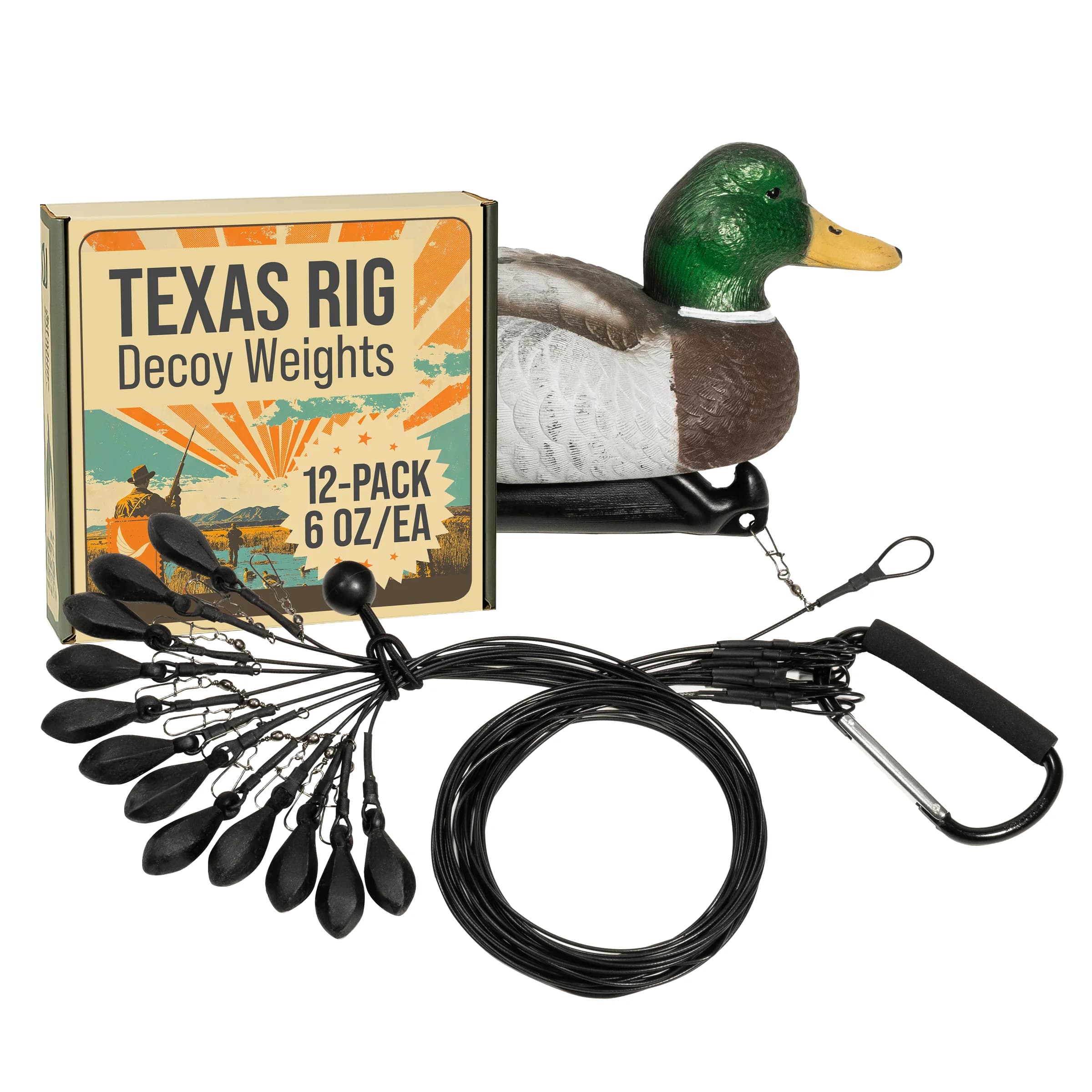
The Lirben kit uses twelve flat black 6 oz bank weights on 48-inch PVC-coated steel cable. It includes a cushioned carabiner and bungee ball for organizing the rigs. It does not include strap, J or mushroom alternatives.
The catalog positions the kit for ducks and light goose decoys in shallow water up to 3 ft. Check actual hold and line reach within that intended use. If another shape or system is needed, buy equipment intended for the job rather than reshaping the supplied weight or attaching loose extra weights to a factory rig.
Common questions
Are mushroom weights always better in mud?
A bottom-gripping design may be worth considering, but the shape name alone is not a guarantee. Check the specific anchor, line reach, actual hold and whether it can be retrieved safely.
Is a J-shaped weight a hook for underwater snags?
Its recognizable role in the examples above includes stowing against a decoy keel. Do not treat a storage hook as permission to snag submerged objects.
Can I replace just the anchor on a pre-rigged cable?
Only follow an appropriate assembly method with compatible replacement parts. Changing a crimped factory rig affects the complete assembly. Consult the line and hardware guide before rebuilding.
Sources and limits
Primary manufacturer links support the construction and storage examples. The bottom table is an observation checklist, not a comparative field test. No anchor material, lead-free status, service life or holding threshold is inferred from color or shape.
For your next setup
Lirben Texas Rig Decoy Weights - 6 oz (12-Pack)
Twelve individual rigs. Choose the fit for your water.