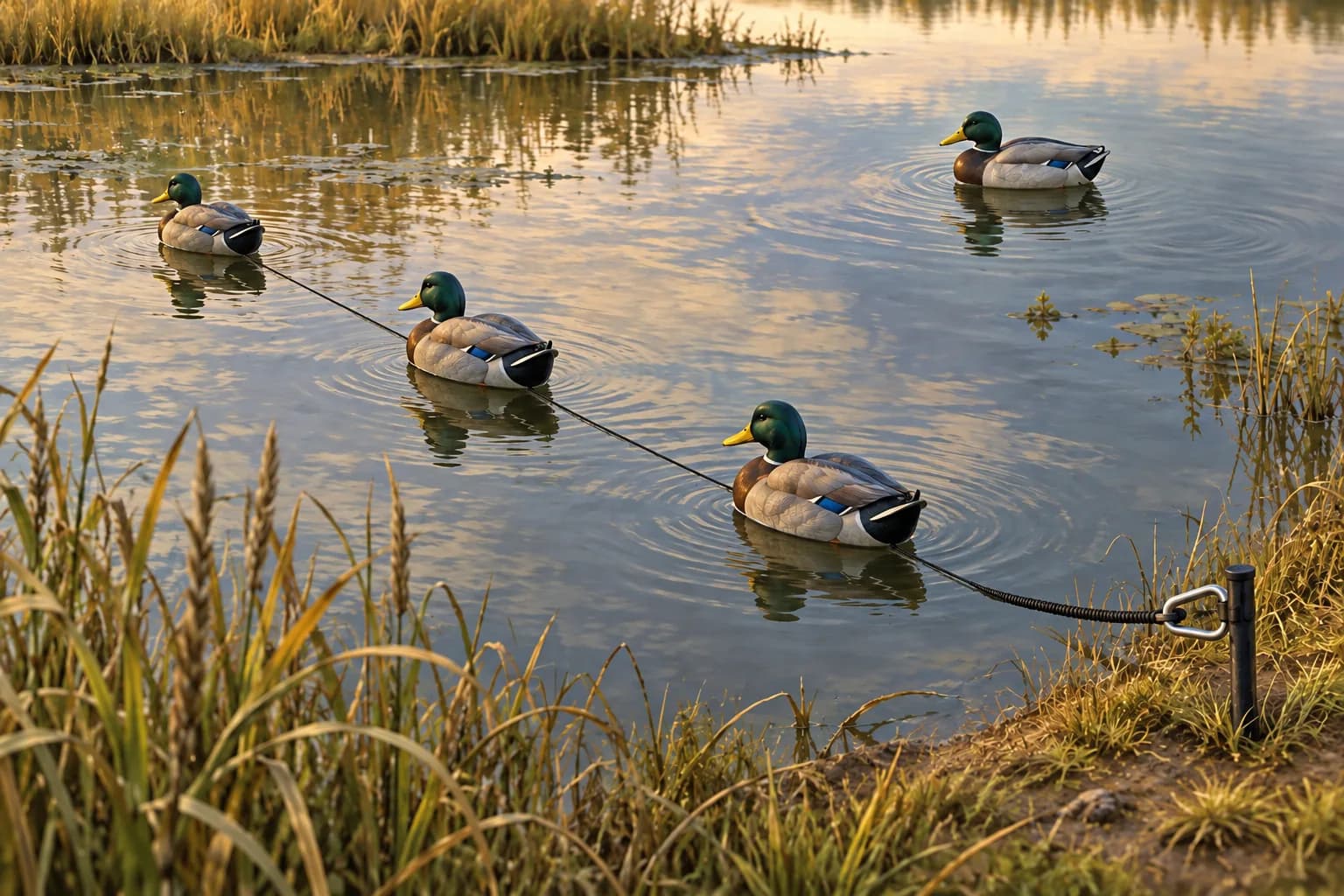
A duck decoy jerk rig uses a hand-operated line to move connected decoys and create ripples. A common arrangement combines an anchor, elastic return section, main line and decoy attachments. It performs a different job from an individual Texas rig, which anchors one decoy without a hand-operated motion line.
Lead image: AI-generated editorial illustration. The motion system is an example, not a Lirben product or a scale assembly diagram.
How does a jerk string work?
In the arrangement described by Ducks Unlimited's jerk-string guide, the operator pulls a line against an anchored bungee section. The line moves the attached decoys; the elastic section returns them when the pull is released. The result is movement on the water without an electric motor.
Different kits connect and manage those parts differently. Some have dedicated short decoy drops, while others position connections directly on a line. Read the supplied instructions before attaching decoys or substituting a line, anchor or return cord.
Individual Texas rig
- Primary job
- Hold one floating decoy at its placement
- What controls the decoy
- Its own anchor and suitable line
Manual jerk rig
- Primary job
- Move connected decoys through a controlled pull and return
- What controls the decoy
- A shared motion line, anchor and return arrangement
Longline or gang rig
- Primary job
- Organize multiple decoys on a shared main line
- What controls the decoy
- The main-line anchoring system and individual drops
Motorized motion decoy
- Primary job
- Produce the movement designed for that product
- What controls the decoy
- Its motor, controls and specified placement or anchoring
| Feature | Primary job | What controls the decoy |
|---|---|---|
| Individual Texas rig | Hold one floating decoy at its placement | Its own anchor and suitable line |
| Manual jerk rig | Move connected decoys through a controlled pull and return | A shared motion line, anchor and return arrangement |
| Longline or gang rig | Organize multiple decoys on a shared main line | The main-line anchoring system and individual drops |
| Motorized motion decoy | Produce the movement designed for that product | Its motor, controls and specified placement or anchoring |
A system name does not tell you that every part is compatible. Use the rig-system comparison for the anchoring choice and the longline setup guide for a shared line without manual pull operation.
Set up the jerk rig around the spread
Step 1
Plan the working line and clear space
Choose a route between the operating position and the decoy group that stays clear of other rigs and movement paths.
Mark the intended operating position and moving decoy group on your spread plan. Plan a clear line route between them. Allow space for the decoys' entire movement, not just where they sit at rest.
Keep the route clear of independent anchors, vegetation, access paths, feet and equipment. Consider the path of a working dog as well. A taut line can be harder to see than the decoys above it. Choose another position if you cannot keep the working route manageable.
Step 2
Set the matched motion system
Install the anchor, return section, main line and decoy connections by the particular system's instructions.
Use the system's specified anchor, return section, main line and decoy connectors. Inspect the elastic for damage and examine every closure. Follow its assembly order and depth requirements. Do not take another kit's dimensions as permission to use an improvised anchor or unknown bungee.
Attach the decoys at the points intended by their maker. Decide how the system expects individual anchor rigs to be removed, retained or kept clear. Do not leave an extra individual anchor attached by habit if it prevents the motion system from working as designed.
HEYDAY's motion-system FAQ is one example of a maker using a main line with separate decoy drops. That design differs from a line with permanently positioned connectors. Use its directions only for the corresponding system.
Step 3
Test movement and return
Use controlled pulls to check the working travel, return and line clearance before relying on the setup.
From a safe, stable operating position, make a small controlled pull and release. Watch the anchor position, decoy posture, movement and return. Increase travel only within the equipment's instructions and available clear space.
Stop if a decoy tips, one drop catches another, the anchor walks toward you or the return section fails to recover normally. Find the cause instead of pulling harder. Check the whole travel path again after moving a decoy or adding another connection.
Do this practice before the hunt, in daylight where you can see the assembly. If the operating position changes, the line route changes too. Spare line should remain controlled and clear of people and equipment rather than lying in open coils underfoot.
Step 4
Pick up without a loose-line pile
Control the line and return section during pickup, then clean, inspect and organize the system.
Keep the return section and main line under control while taking the system out of use. Follow the maker's procedure for releasing tension and disconnecting parts. Avoid reaching into a stretched or snagged assembly while someone else is pulling it.
Bring the line, connections and anchor in deliberately. Remove debris, isolate damage and store the parts so the next deployment starts with the correct end and connection. Keep the motion line separate from bundles of individual rigs.
The Texas rig storage guide covers individual bundles. Apply the same habit of separating crossed lines early, while following your motion system's different storage method.
If the system supplies a winder or carrying bag, use it to control the line without trapping a stretched return section. Keep the first end accessible rather than burying it under the decoys. Use the maintenance checklist before returning worn elastic or damaged clips to service.
How many decoys should go on the jerk string?
Start with the system's supported arrangement and a group you can control. Decoy size, connectors, available movement and the return section affect the setup. An unused clip is not a reason to add another decoy.
Choose the wider spread using the decoy-count guide, then assign only the intended moving group to the jerk rig. Watch the decoys through the full movement before putting other individually anchored birds nearby.
Does a jerk rig replace every anchor?
No. The jerk system has its own anchoring and connection design. Separately placed birds outside it still need suitable individual anchoring. A motion line should not cross their working lines or pull them out of position.
If a moving decoy is pulled low, a static anchor may be obstructing it, but other causes are possible. Inspect the actual setup. The rig troubleshooting guide helps separate tight reach, a caught connector, a drifting anchor and a decoy-body problem.
Is Lirben's bungee ball a jerk-rig return?
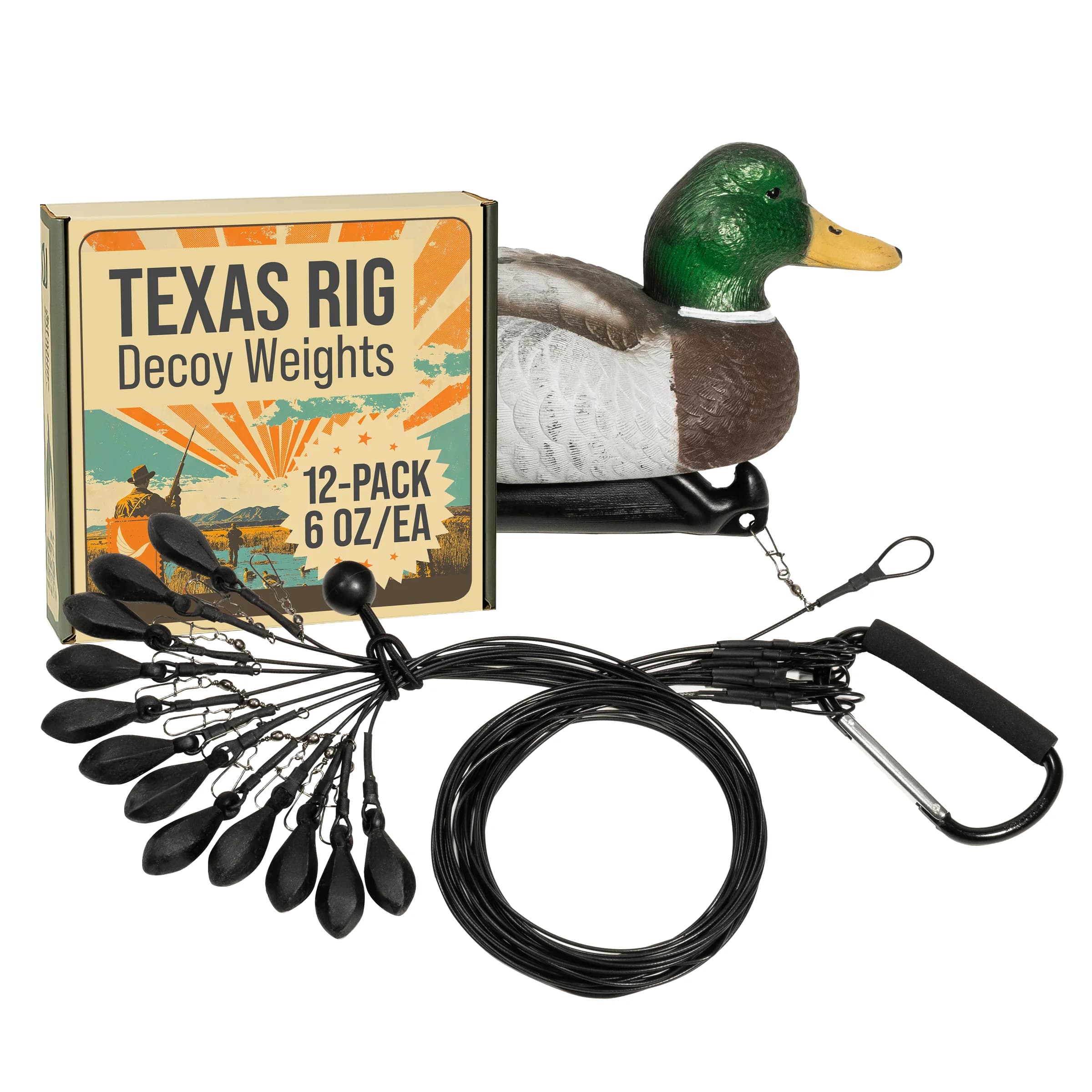
Lirben lists the bungee ball as a storage accessory in its 6 oz individual rig kit. The kit includes 48-inch PVC-coated steel lines and individual weights. It does not include a motion main line or a return bungee specified for a jerk system.
Do not infer an elastic working range, load rating or motion-system use from the presence of a storage bungee. Use a purpose-built motion system when that is the task. Consider the Lirben kit for separate shallow-water placements whose depth and connections match its specifications.
Common questions
Will a jerk rig always improve the hunt?
No equipment guarantees how birds will respond. A manual line gives you a way to add controlled movement, especially when the water is still. Observe the spread and stop or adjust motion when it does not suit the situation.
Is a hand-operated rig allowed everywhere?
Check the current rules for the jurisdiction and the specific hunting area. Manual and powered equipment may be treated differently, and a maker's broad statement is not the local rule. Do not assume permission from the absence of a motor.
What if the line pulls the anchor toward the blind?
Stop using it and recover the system safely. Check the anchor's actual hold, the arrangement and the instructions. Shortening the return or pulling more forcefully does not establish that the anchor is suitable.
Sources and limits
The linked Ducks Unlimited article explains a common manual-return arrangement; HEYDAY documents one commercial variation. The setup checklist focuses on inspection and clearance. It is not a tested parts recipe, a cross-brand compatibility approval or a promise of hunting results.
For your next setup
Lirben Texas Rig Decoy Weights - 6 oz (12-Pack)
Twelve individual rigs. Choose the fit for your water.